Public Beta · Reference parameters captured Nov 2026. The canal is operational with metered lockage from 1 Jan 2027. The 40% headline is a modeled estimate versus road charter with oversized permits; corridor benchmarks (18–30% comprehensive saving, −560 km on the Baise axis) are reported figures cited in the sources below. Freight rates are planning context, not quotes — verify at booking. Spotted a discrepancy? Tell us — this page exists to be challenged.
1. The Heavy Cargo Dilemma in China-ASEAN Sourcing#
For industrial buyers in Vietnam, Indonesia, and Thailand, procuring heavy machinery (excavator attachments, crusher housings, structural mill frames, and industrial castings) from inland Chinese manufacturers historically incurred prohibitive domestic logistics costs.
Overland heavy-haul trucking across the Sino-Vietnamese border requires:
- Costly low-bed semi-trailer charters;
- Inter-provincial oversized cargo permits and highway toll surcharges;
- High risk of cargo damage from road vibration and border transfer hoisting.
The operationalization of the Class I inland waterway (Pinglu Canal) directly dissolves this barrier. Inland river quays equipped with high-tonnage gantry cranes can now load heavy industrial modules directly onto 5,000 DWT roll-on/roll-off and deck barges.
2. Where the 40% Comes From — and Where It Doesn't#
Strip the number down before using it. Against a low-bed charter plus oversized permits plus highway surcharges, a 5,000 DWT deck barge moving 1,500–2,500 t per sailing replaces dozens of truck trips — and the water leg's unit cost is structurally lower on every corridor where it has been measured. The reported corridor benchmark for standard container and bulk cargo is 18–30% comprehensive logistics cost reduction versus the old Pearl-River-Delta detour (People's Daily Overseas Edition, citing Guangxi MSA); heavy cargo sits above that band because the road-side premium it avoids — escort vehicles, permit fees, bridge surveys, night-move restrictions — is proportionally steeper than for boxed freight. Our modeled planning estimate for oversized industrial cargo on this corridor is therefore up to 40%, assembled from:
| Cost layer | Road heavy-haul | Canal barge leg |
|---|---|---|
| Line-haul unit cost | High (per-truck, per-km, fuel + tolls) | Low (per-tonne, per-km, convoy-scale) |
| Oversized permits & escorts | Yes, per province | None on water |
| Trans-shipment damage risk | Border hoist events | Crane-to-crane, lashed on deck |
| Schedule exposure | Road restrictions, weather | Lock cadence (metered from 2027) |
Treat 40% as the ceiling of a planning range, firm it up per-shipment in the cost simulator, and never as a quoted rate. For the corridor's underlying verified benchmarks, see the first-month industrial ledger.
3. The Sourcing Side: Which Guangxi Clusters Produce This Cargo#
The canal does not create the supply — it connects clusters that already exist. Three belts matter for heavy and oversized buyers:
- Liuzhou machinery: the city's engineering-machinery and auto-industry base (capacity and export data in the EV-belt playbook) produces hydraulic assemblies, gearboxes, and fabricated frames with export-grade quality systems — the same industrial discipline now shipping vehicles at +279% growth.
- Xijiang-corridor fabrication: structural steel and industrial casting shops along the Xijiang (Guigang, Wuzhou axis) serving construction and mining OEMs; these plants routinely build to Australian and ASEAN specifications because their traditional export route ran east through the delta ports.
- Nanning–Liujing heavy quays: the 40-t gantry crane at Liujing now transships at 800 t/h with direct ship-to-ship capability (per the first-month ledger) — the loading hardware heavy cargo needs already exists at the river origin.
For buyers qualifying suppliers, the verified supplier directory application is the entry point; for cluster-level context, the industrial use-cases review.
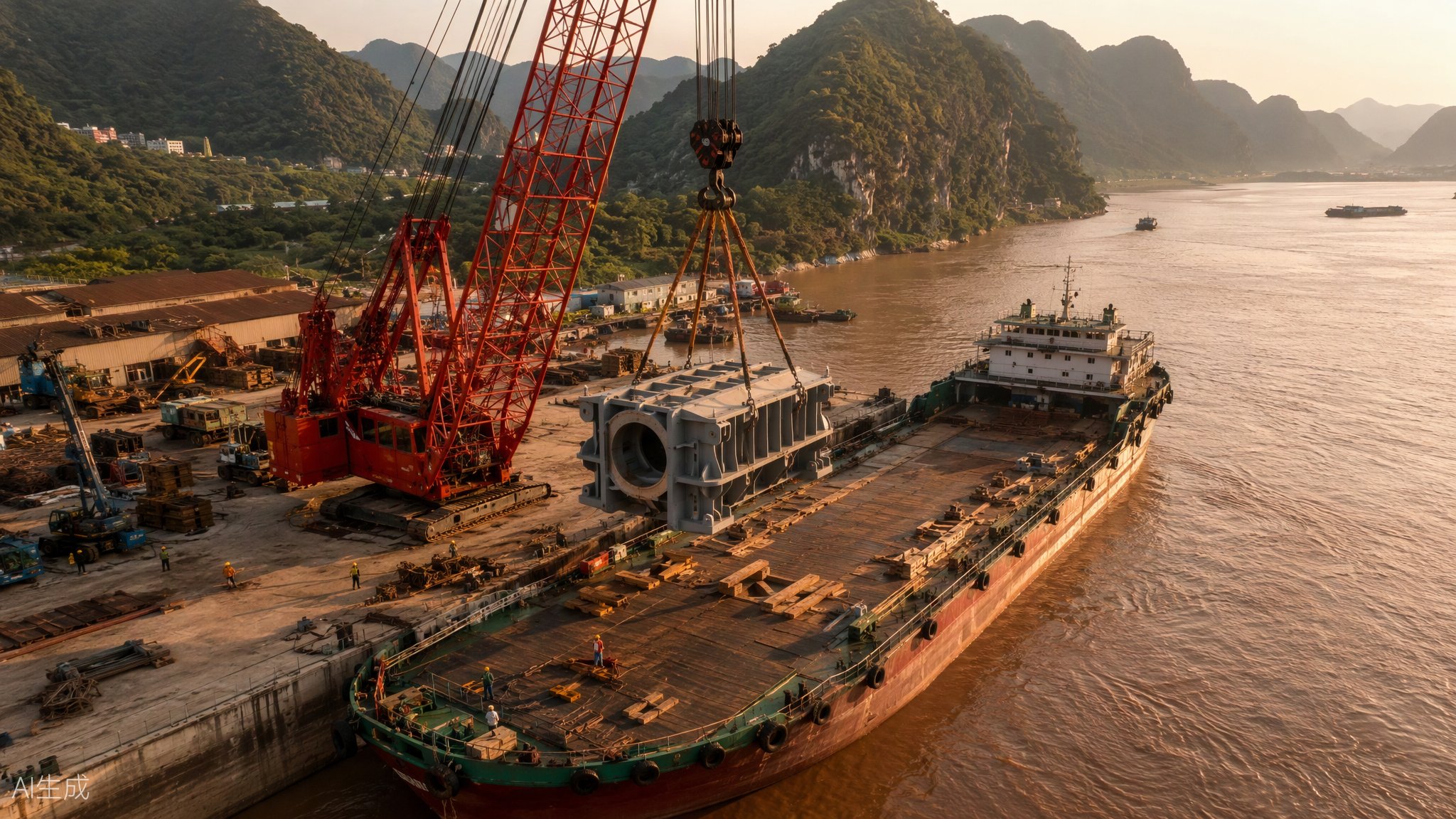
The load that changes the math: a mining-gear housing moving crane-to-crane from river quay to deck barge — no border hoist, no low-bed charter, no provincial permit file.
4. The Transfer Mechanics: River Quay to Ocean Berth#
Oversized cargo fails on handoffs, so the chain matters more than any single node:
- River origin loading — Nanning (Liujing/Niubay), Guigang, or Liuzhou quays with 40–100 t gantry or crawler capacity; cargo is lashed and dunnaged on deck at origin, documented once.
- Canal transit — 134 km, Class I channel, scheduled 5,000-t convoys; lockage free through 31 Dec 2026, then RMB 1.0/gross-tonne (planning noise on a heavy-cargo cost stack — see the lockage guide).
- Sea-side heavy transfer — the 13 retrofitted river-sea berths at Qinzhou (≈32M t added capacity, all complete per the first-month ledger) take the barge alongside ocean feeders or heavy-lift tonnage; module moves crane-to-crane directly onto the sea vessel.
Each step is a crane cycle, not a warehouse stay. That is the operational core of the saving: heavy cargo's biggest cost is not distance, it is handling events, and this corridor removes most of them.
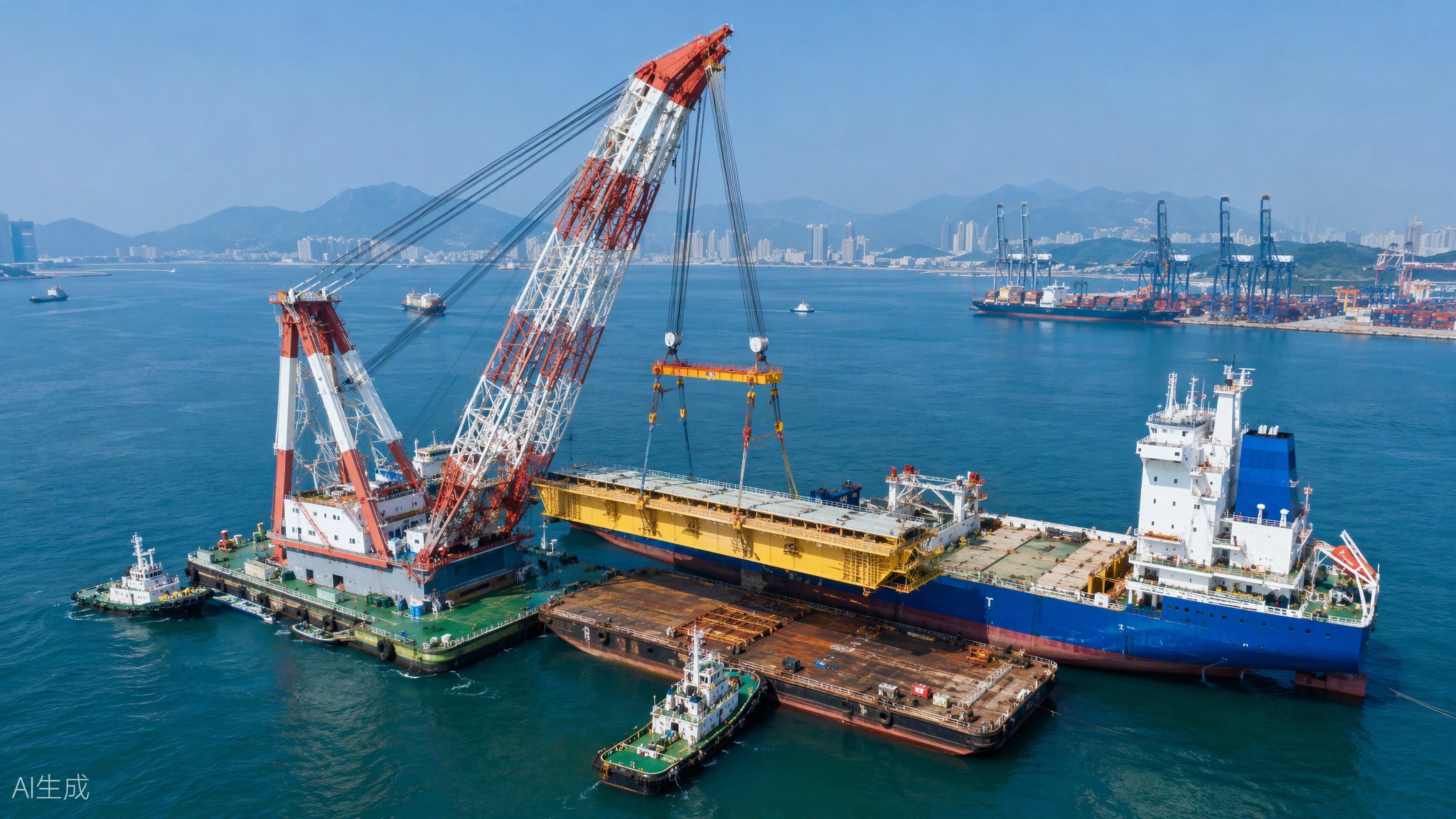
The sea-side handoff: one floating-crane cycle moves the module from river barge to ocean vessel at Qinzhou's retrofitted berths. Every handoff removed is money saved — and claims avoided.
5. Procurement Checklist for ASEAN Buyers#
- Specify lift points and lashing plan at RFQ — suppliers on this corridor quote FAS river-quay naturally; asking for it upfront keeps the road leg out of the price.
- Book deck space, not container slots — 5,000 DWT deck barges carry out-of-gauge (OOG) modules; confirm stowage drawings before contract.
- Seasonality: dry-season convoy cadence is densest Oct–Apr; CNY weeks tighten both road and water — plan heavy arrivals around February (see the 30-day operations audit for cadence data).
- Insurance: crane-to-crane chain reduces claims frequency; negotiate marine cargo terms that name each handoff point.
- Documents: river-port-of-origin export clearance (the "single declaration" models now live at Guigang and Nanning) makes the cargo financeable before it reaches the sea.
FAQ#
Is 40% a guaranteed saving?#
No. It is a modeled planning ceiling versus road heavy-haul with permits. Verified corridor benchmarks for standard cargo are 18–30% comprehensive (reported). Your saving depends on module dimensions, origin quay, and season — model it per shipment.
Can breakbulk and containers share one convoy?#
Yes — scheduled 5,000-t convoys mix containers, bulk, and deck cargo. Confirm OOG stowage at booking; heavy modules typically reserve the full deck forward of the house.
Which ASEAN ports are the natural landfalls?#
Haiphong for northern Vietnam projects, Jakarta/Cikarang for Indonesian mining and construction, Laem Chabang for Thailand — feeder sailings from Qinzhou exist on all three legs; see the Qinzhou–Jakarta 40HQ breakdown for container-side context.
Does the 2027 lockage fee hurt heavy cargo economics?#
Marginally. RMB 1.0/gross-tonne per lockage is single-digit RMB per tonne of cargo — noise beside the road-side premiums this corridor removes.
Methodology & Data Sources#
Corridor benchmarks (−560 km Baise axis, 5–7 day transit, 18–30% comprehensive cost band) are from People's Daily Overseas Edition (23 Sep 2026, citing Guangxi MSA); berth and crane capability (13 retrofitted berths ≈32M t, Liujing 40-t crane at 800 t/h) from Guangxi Daily's first-month operations review; lockage terms from the published 2027 tariff notice. The 40% headline is this desk's modeled planning estimate for oversized cargo versus road charter, constructed from the cost-layer table above and labeled as such. No unsourced freight rates are published per this site's sourcing rules.
- Corridor benchmarks: ~650 km vs ~1,200 km, 5–7 days vs 12–15, −18% to −30% comprehensive — People's Daily Overseas Edition, 23 Sep 2026
- Estuary capacity: 13 berths complete, ≈32M t added river-sea capacity; Liujing 40-t crane 300→800 t/h — Guangxi DailyA, Oct 2026 (via SohuB)
- Lockage: free to 31 Dec 2026; RMB 1.0/GT from 1 Jan 2027 — Guangxi DRC hearing briefingS (see lockage guide)
- Cluster context: Liuzhou export base — EV-belt playbook; container-side ASEAN legs — Qinzhou–Jakarta breakdown; cadence — 30-day audit
Get a Tailored Logistics Assessment#
Run your module through the cost simulator — Liuzhou, Nanning, and Guigang origins priced, OOG stowage included — or apply to be listed in the verified supplier directory. Reference values only; not a formal quote.