Public Beta · Reference parameters captured Oct 2026, cross-checked to canal operations through Oct 11. These are planning estimates, not a formal quote. Spotted a discrepancy? Tell us — this page exists to be challenged.
Key Numbers (Three Verticals)#
| Metric | Reference value |
|---|---|
| Chongzuo sugar containerization | 230 Zhonggu Logistics standard containers at Jiangjunling operating area (first river-sea container call, Oct 2026) |
| Crane productivity at Jiangjunling | 20 → 30 TEU/h after spreader/process tuning |
| Chongzuo sugar base | Sugarcane > 4M mu; output ≈ 1/3 of Guangxi, 1/5 of China |
| Lee & Man machinery inbound | 25 containers, wet pulp machine, Qinzhou → Guigang 3 days |
| Lee & Man project | RMB 22.5bn, two phases; phase 1 (RMB 10bn): 1Mt bleached chemical pulp + 800kt tissue, production from Jun 2027 |
| Guigang canal traffic (Sep 16–Oct 11) | 99,500 t total; incl. 3,475 TEU, coal 18.9kt, iron ore 9.2kt, steel 16.1kt, fertilizer 9.6kt |
| Suwan berth upgrade | 8.6 m spreader retrofit completed after opening |
| Guangxi ASEAN fruit imports 2025 | 2.8919M t, >1/3 of national total; ~1 in 2 imported durians via Guangxi |
| Wuming mandarin exports 2025–26 season | 298,000 t, ≈ RMB 1.8bn, to 30 countries |
| Canal cumulative throughput | > 1M t by late Oct 2026 |
1. Cold Chain & Agriculture: The Two-Way Fruit Loop Gets Infrastructure#
For years the China–ASEAN fruit trade ran on trucks: Thai and Vietnamese durians crossed at Friendship Pass by road, then re-loaded for the long haul inland. The canal adds a water alternative exactly where fruit logistics hurts most — vibration, temperature drift and per-km cost. The structural data is already large: Guangxi's ports cleared 2.89M tonnes of ASEAN fruit in 2025, more than a third of China's national total, and roughly every second durian imported into China enters through Guangxi. China's side flows the other way: the 2025–26 season shipped 298,000 t of Wuming mandarins worth about RMB 1.8 bn to 30 countries.
October 2026 put an institutional wrapper around this flow. The 2026 Guangxi International Agriculture Expo (Oct 23–25, Nanning) — the first international agri fair after the canal opened — ran a China–ASEAN fruit industry conference alongside, and for the first time the "ASEAN grows, Guangxi consolidates, China sells" loop had a physical waterway underneath the pitch. Hainan attended as guest province, adding a second layer: raw material enters via Guangxi's canal corridor, processes in Hainan's free trade port (zero-tariff imports, low enterprise tax, free cross-border capital), then re-exports under a "made-in-FTZ" label. For ASEAN growers and Chinese processors alike, that is a policy-arbitrage lane, not just a freight lane — and it is genuinely new: before the canal, the same cargo would have transited the Pearl River Delta with an extra handling step and no FTZ chemistry.
Planning note for buyers: fresh-fruit economics on this corridor are documented in our Thai fruit CNY booking-window analysis and the ASEAN Spring Festival fruit forecast. The canal leg itself is free of lockage through 31 Dec 2026 (operations audit).
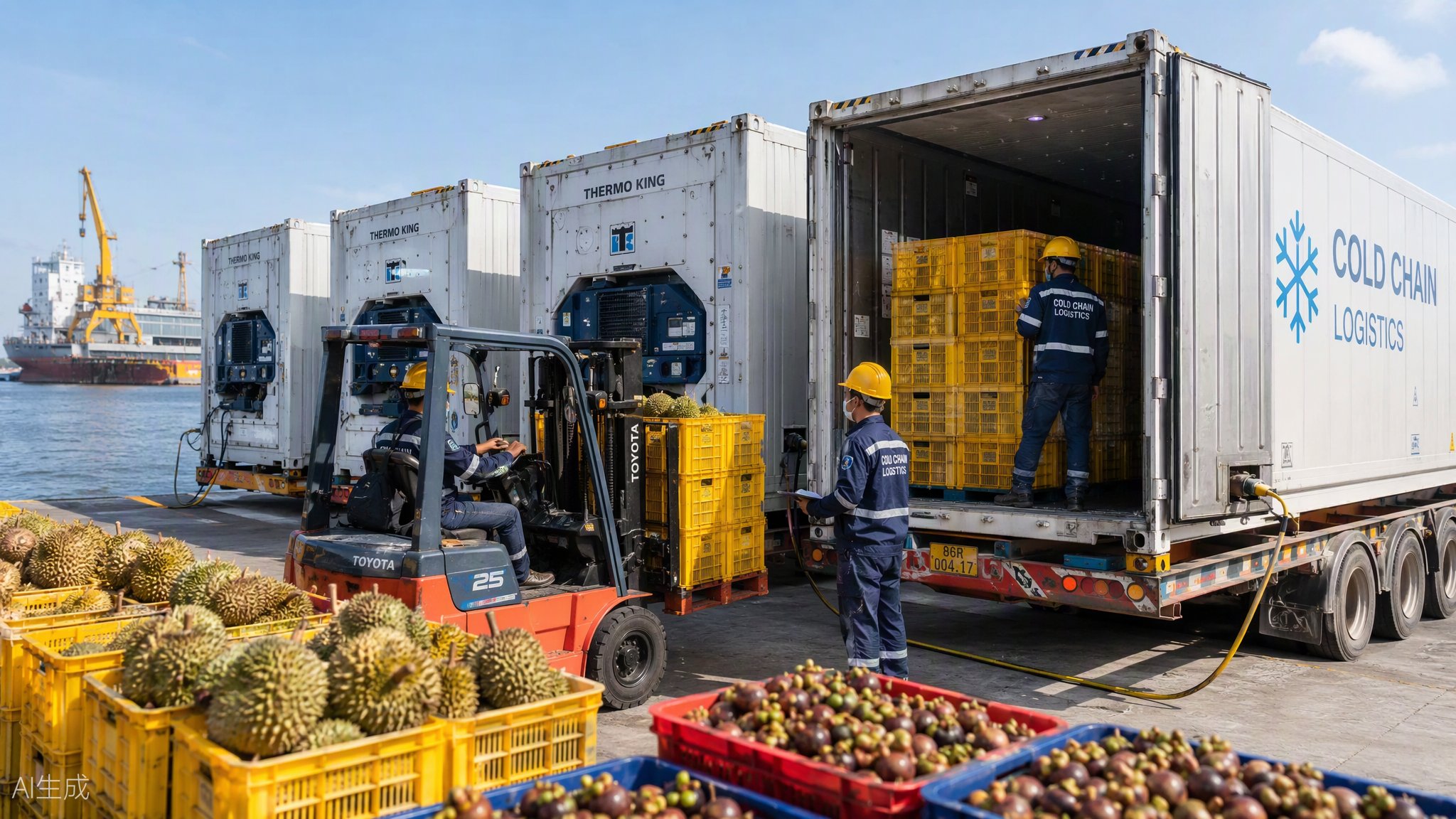
Cold chain is the highest-margin cargo the canal can attract: ASEAN durian and mangosteen into the Southwest hinterland, Guangxi citrus back out. 2025 baseline: 2.89M t of ASEAN fruit through Guangxi ports.
2. Bulk Agriculture Goes Container: Chongzuo Sugar and "Doorstep FCL"#
The second case answers a question every overseas forwarder asks about inland China: can my cargo stuff into an ocean container at the factory gate, or does it break-bulk to a coastal terminal first? Chongzuo — "China's sugar capital," with 4M+ mu of sugarcane and one-fifth of national sugar output — just answered it.
In mid-October 2026, two river-sea vessels (Anda 8688 and Xiangyun 6328) berthed at the Jiangjunling operating area of Fusui port — the area's first river-sea container call — with 230 Zhonggu Logistics standard containers for sugar loading. The operational details matter more than the headline: Jiangjunling pre-staged a dedicated empty-sugar-box stacking zone, trained stevedore crews for the new flow, configured specialized spreaders, and lifted crane productivity from 20 to 30 TEU/h. Sugar boxes get zoned storage, a named contact, and priority clearance — a "one ticket to destination" tracking service.
The systemic point: refined sugar and food ingredients leaving Chongzuo previously rode trucks 300+ km to Qinzhou for stuffing. Now they load once at the factory's river port, ride the Zuo River into the Pinglu Canal, and hit deep water at Qinzhou. One less handling cycle means less bag breakage and moisture risk — for food-grade cargo, that is the whole game. Chongzuo's fertilizer, construction materials and agricultural inputs follow the same path outbound, and the corridor's return direction (see the machinery case below) is already filling with industrial cargo.
For bulk-to-container planners, this mirrors the national "散改集" (bulk-to-box) playbook on a newly opened waterway — the same logic that underpins our Haiphong cost breakdown and Jakarta 40HQ analysis, now proven at a county-level river port.
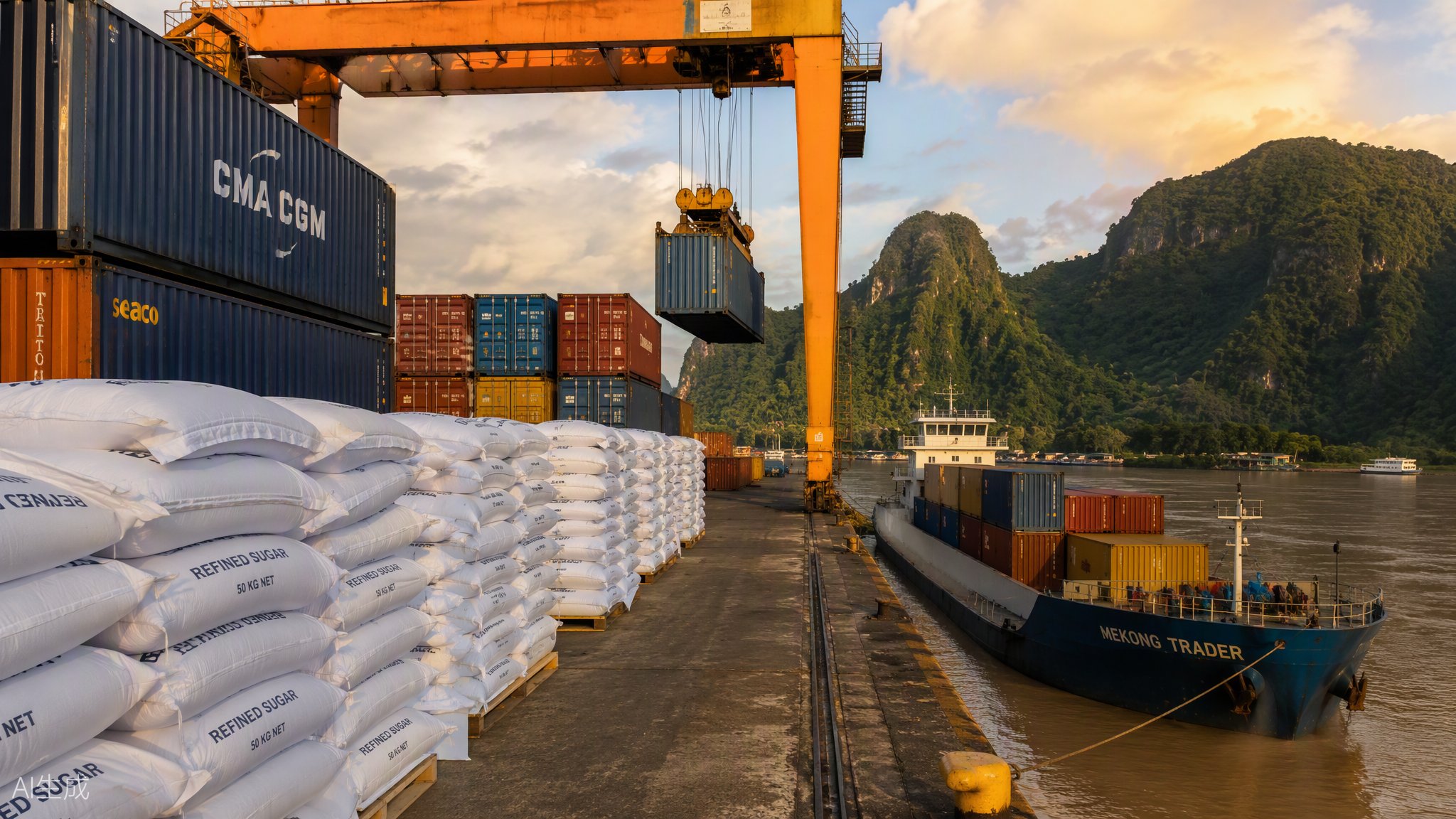
"Doorstep FCL" goes inland: 230 Zhonggu Logistics boxes for sugar at Jiangjunling operating area — factory-gate stuffing on the Zuo River, then straight down the canal to Qinzhou.
3. Heavy Machinery Inbound: Lee & Man and the Two-Way Industrial Corridor#
The third case is the one industrial buyers should study. On 12 Oct 2026, the Guigang Suwan operating area unloaded 25 containers of imported pulping machinery (wet pulp machine) that had sailed from Qinzhou upstream through the Pinglu Canal in 3 days. The equipment is bound for the Lee & Man Paper plant in the Yuegui Circular Economy Industrial Park — a RMB 22.5bn two-phase project (phase 1: RMB 10bn, 1Mt bleached chemical pulp + 800kt tissue), currently ~30% built with production slated for June 2027.
Why this matters for procurement planning:
- Inbound heavy logistics is de-risked. A 10-billion-yuan plant lives or dies on installation schedules. Machinery moving port-to-plant in 3 days at 18–30% lower integrated logistics cost (company-cited) means the canal now competes for project cargo, not just commodities.
- The raw-material loop is pre-wired. Post-startup, the plant will import wood chips from Southeast Asia in volume and export finished tissue and packaging to ASEAN markets — upstream raw in, downstream product out, on the same waterway.
- The port is upgrading to meet it. Suwan completed an 8.6 m spreader retrofit after opening to close a bridge-crane handling gap, and Guigang's three operating areas (Suwan, Luobowan, Mao'ershan) already moved 99,500 t via the canal by Oct 11 — 3,475 TEU plus coal, iron ore, steel and fertilizer. Suwan is even planning a Suwan–canal–Hainan service to tap the Hainan FTP construction market.
The pattern generalizes: any ASEAN-facing manufacturer considering Southwest China inland siting now has a documented template — heavy inbound by water, raw-material replenishment by water, finished goods out to ASEAN by water. See how this corridor compares for plant logistics in our Malaysia lane analysis.
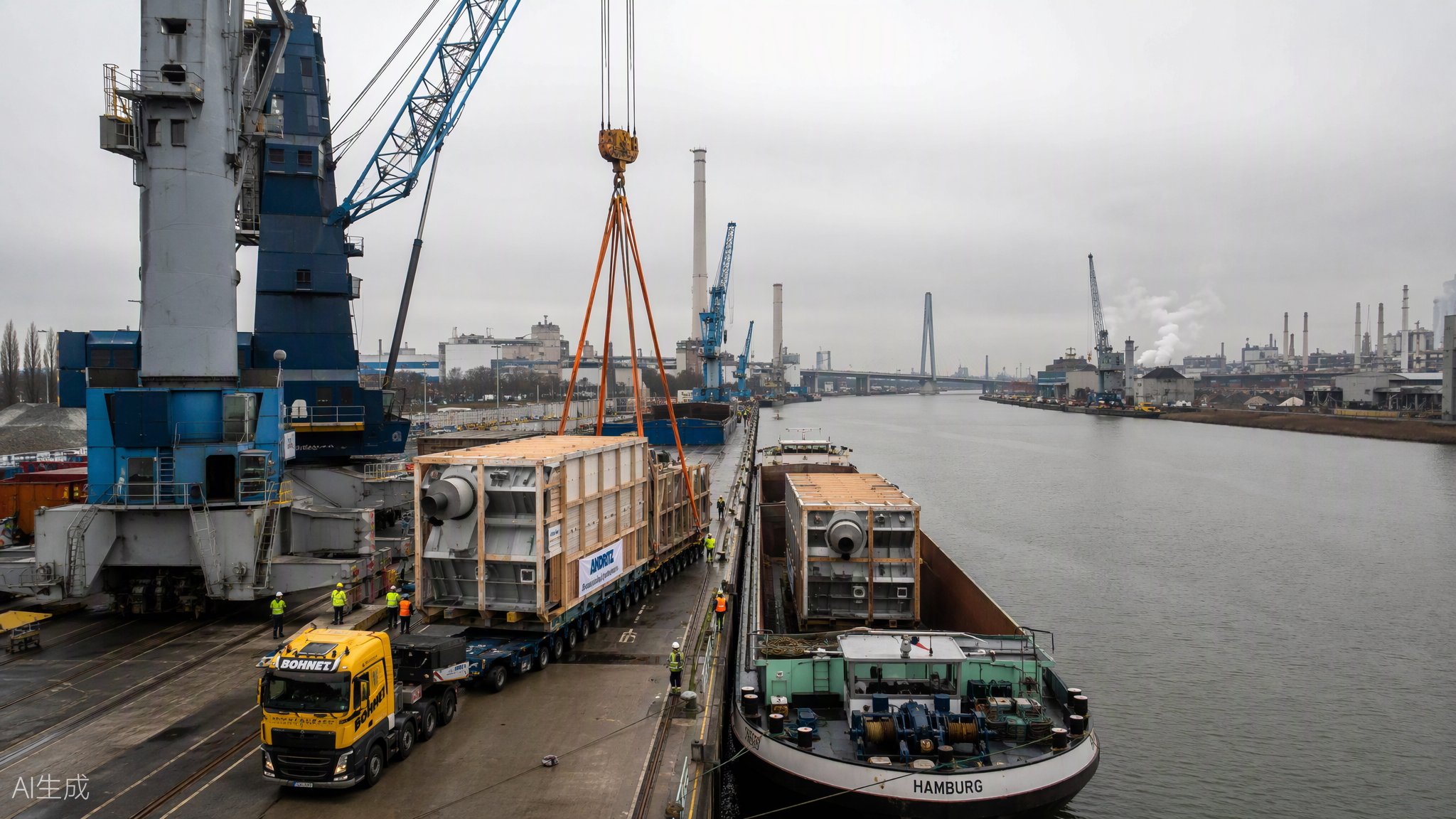
Heavy inbound works: 25 containers of pulping machinery offloaded at Suwan, Guigang — Qinzhou to plant site in 3 days. The same berth later ships the plant's ASEAN-bound output.
4. What This Means for Shippers#
- High-value cargo no longer needs a coastal origin. Three verticals — perishables, food-grade bulk, industrial plant — all moved on the corridor in a single month, each with a named operator (Zhonggu Logistics, Beibu Gulf Port Group terminals, Lee & Man).
- Watch berth-level capability, not just the canal. Jiangjunling's 20→30 TEU/h tune-up and Suwan's 8.6 m spreader show the corridor improving at terminal granularity. Your cargo's actual experience is set by the operating area, not the waterway average.
- Lockage is free through 31 Dec 2026; the 2027 trial rate (RMB 1.0/GT/lockage) is noise-level per container (audit). Budget 2027 quotes accordingly.
- Preferential tariffs need clean origin paperwork. Fruit, sugar products and paper goods all benefit from RCEP/ACFTA rates with valid Form E — see the rules-of-origin checklist.
FAQ#
Is the canal ready for reefer cargo?#
The corridor's reefer capability is anchored at Qinzhou's cold-chain terminals, with fruit express lines at 3-day-class transit. The inland canal leg adds no reefer infrastructure of its own yet — plan reefer power at the seaport handoff, and treat the canal as the low-cost inland trunk from there.
Can bulk cargo really stuff into containers at inland river ports now?#
Chongzuo is the working proof: 230 sugar boxes loaded at a county-level operating area with dedicated stacking, spreaders and priority clearance. Capability is berth-specific — confirm with the operating area before routing.
What does the Hainan free-trade-port angle add?#
A processing-and-re-export option: ASEAN raw materials enter via Guangxi/canal, manufacture or brand in Hainan (zero-tariff imports, low enterprise tax), then sell domestically or re-export. It is a customs-structure play on top of the freight saving — worth modeling for commodity processors.
How do I get a factory-gate rate for sugar, fruit or machinery lanes?#
The cost simulator handles standard FCL lanes from the basin; for heavy-lift, reefer or bulk-to-box projects, submit the specifics through the verified directory application and reference these three cases.
Methodology & Data Sources#
All figures are drawn from official or operator-sourced reporting dated Oct 2026, cross-checked across at least two outlets where possible. Where sources disagree (project investment), the national wire-service figure is used and the variance noted. No unsourced freight rates are published.
- 230 Zhonggu Logistics containers, Anda 8688 / Xiangyun 6328 first river-sea call at Jiangjunling; crane efficiency 20→30 TEU/h; dedicated sugar-box stacking and priority clearance; Chongzuo 4M mu / 1/3 Guangxi / 1/5 national sugar output — China News ServiceA (活力中国调研行), 15 Oct 2026 (via Toutiao)
- Lee & Man 25-container wet pulp machine, Qinzhou → Guigang Suwan in 3 days, 18–30% integrated logistics cost reduction; RMB 22.5bn two-phase project (phase 1 RMB 10bn: 1Mt pulp + 800kt tissue, Jun 2027 production, ~30% built); wood-chip imports from SEA and ASEAN market exports post-startup — China News Service, 15 Oct 2026; note local Guigang publicity cites RMB 27.5bn total investment (variance unverified)
- Suwan 8.6 m spreader retrofit; Guigang three operating areas 99,500 t via canal Sep 16–Oct 11 incl. 3,475 TEU, coal 18.9kt, iron ore 9.2kt, steel 16.1kt, fertilizer 9.6kt; planned Suwan–canal–Hainan service — Guigang Daily via Guigang News Net / SohuB, 14–15 Oct 2026
- Agri-expo Oct 23–25 2026, China–ASEAN fruit industry conference, Hainan guest province and FTZ processing-reexport model; canal fruit trade framing — China News Service, 15 Oct 2026
- 2025 Guangxi ASEAN fruit imports 2.8919M t (>1/3 national; ~1 in 2 durians); Wuming mandarins 298,000 t / ≈RMB 1.8bn / 30 countries 2025–26 — People's Daily Guangxi, 18 Sep 2026
- Canal cumulative throughput >1M t by late Oct; Nanning Port +145% in opening month — Sina Finance CCTVA-sourced report, 24 Oct 2026; see also the 30-day audit
- Canal corridor 560 km shorter inland leg, 18–30% integrated logistics cost reduction (official projection) — recurring official framing, e.g. China News Service 15 Oct 2026; XinhuaA, 20 Sep 2026
Get a Tailored Logistics Assessment#
Run your own numbers in the cost simulator — or apply to be listed in the verified supplier directory. Reference values only; not a formal quote.