Public Beta · Reporting date 26 Oct 2026. Planning dates below are our arithmetic built on published transit times and stated booking lead times — they are a calendar, not a quote. Spotted a discrepancy? Tell us — this page exists to be challenged.
1. The Clock: Why November Is the Decision Month#
Two structural facts define the 2027 pre-CNY fruit trade:
- An early CNY. Chinese New Year falls on Saturday 6 Feb 2027 (eve 5 Feb) — 11 days earlier than 2026. Pre-CNY retail buying concentrates in mid-January → 3 February, squarely inside the Northeast-monsoon season (Q4–Q1), which adds 1–3 days to South China Sea legs.
- A booking funnel that closes from the ocean side inward. The sea lane — the only lane that moves container volumes at ≈¥1.4/kg for longan (cost math here) — needs 3–4 weeks of booking lead over the window, and its reefer slots are the first thing to sell out.
Work backwards from the shelf and the deadlines look like this (our planning arithmetic on published transit bands):
| Lane | Published transit | Book-by for CNY-window arrival |
|---|---|---|
| Sea, Laem Chabang → Qinzhou → Nanning | 3–6 days sea + 1 day inland; 5–6 sailings/wk | Now → mid-Nov for late-Dec/early-Jan sailings; hard cutoff ≈ 8 Jan for last pre-CNY boxes |
| Rail, China–Laos (Laem Chabang → Mohan → Kunming/Chongqing) | fastest <3 days, winter frequency to daily | Early-mid Jan, but peak weeks' slots tighten from late Dec |
| Road, Bangkok → Chongzuo/Pingxiang → Nanning | 2–5 days door-to-door | Early Jan; capacity is the ceiling, price is the premium |
| Canal barge, Qinzhou → Nanning basin | first CNY with the canal live; frequency ramping | Pilot in December, don't stake January volumes on it yet |
Miss the mid-November sea window and you are not shut out — you are just choosing between rail premiums and road premiums for a commodity whose lane economics assume the sea leg.
2. What We Know as of 26 October#
The October data dump — Kunming Customs' 8 Oct release, Guangxi port figures and operator statements — says the trade is pre-positioning for exactly this window:
- China–Laos rail corridor (Kunming Customs, 8 Oct 2026): cumulative import-export value passed ¥100.4 bn since opening (>25,000 trains, >20.77 Mt, >24% annual growth). Jan–Aug 2026: ¥5.26 bn of durian, mangosteen and longan moved this way, +12.3% y/y; cumulative tropical-fruit imports via the line exceed ¥16 bn. The cold-chain special train runs Laem Chabang → Vientiane (gauge change) → Mohan → Kunming/Chongqing, fastest under 3 days, ≈15% below road cost, spoilage down ~10%.
- Reefer capacity is being added where it hurts: 700+ domestically manufactured reefer containers (CRRC Shijiazhuang) were deployed on the China–Laos corridor this year, per trade-press reporting — the equipment race the pre-CNY crunch usually exposes is being fought in advance. Durian alone moved 120,000 t (+56% y/y) on the line in H1 2026.
- Qinzhou's fruit gateway keeps widening: 9 dedicated fruit lines, fastest Thailand→Qinzhou transit 3 days, 24-hour fruit clearance; National Day week (1–7 Oct) the automated terminal handled a projected 45,000 TEU running 24/7. Guangxi ports took in >1.73 Mt of ASEAN fruit (¥26 bn) in Jan–Jul 2026 — roughly one imported durian in three enters via Guangxi.
- The Pingxiang rail option matured: H1 2026 fruit through the rail port 2,276 TEU (+50.8%); since March, the "Pingxiang–Nanning" fruit cold-chain train runs border-to-Nanning in ~4 hours — a road-bypass trick worth pricing for January.
- Demand-side pull: Thai fruit supply is expected up ~15% y/y into the window; Thai durian Jan–Jul orders to China reached ¥23.4 bn as Vietnam's market share wobbled under compliance scandals — expect Thai-origin cargo to fight harder for every reefer slot this season.
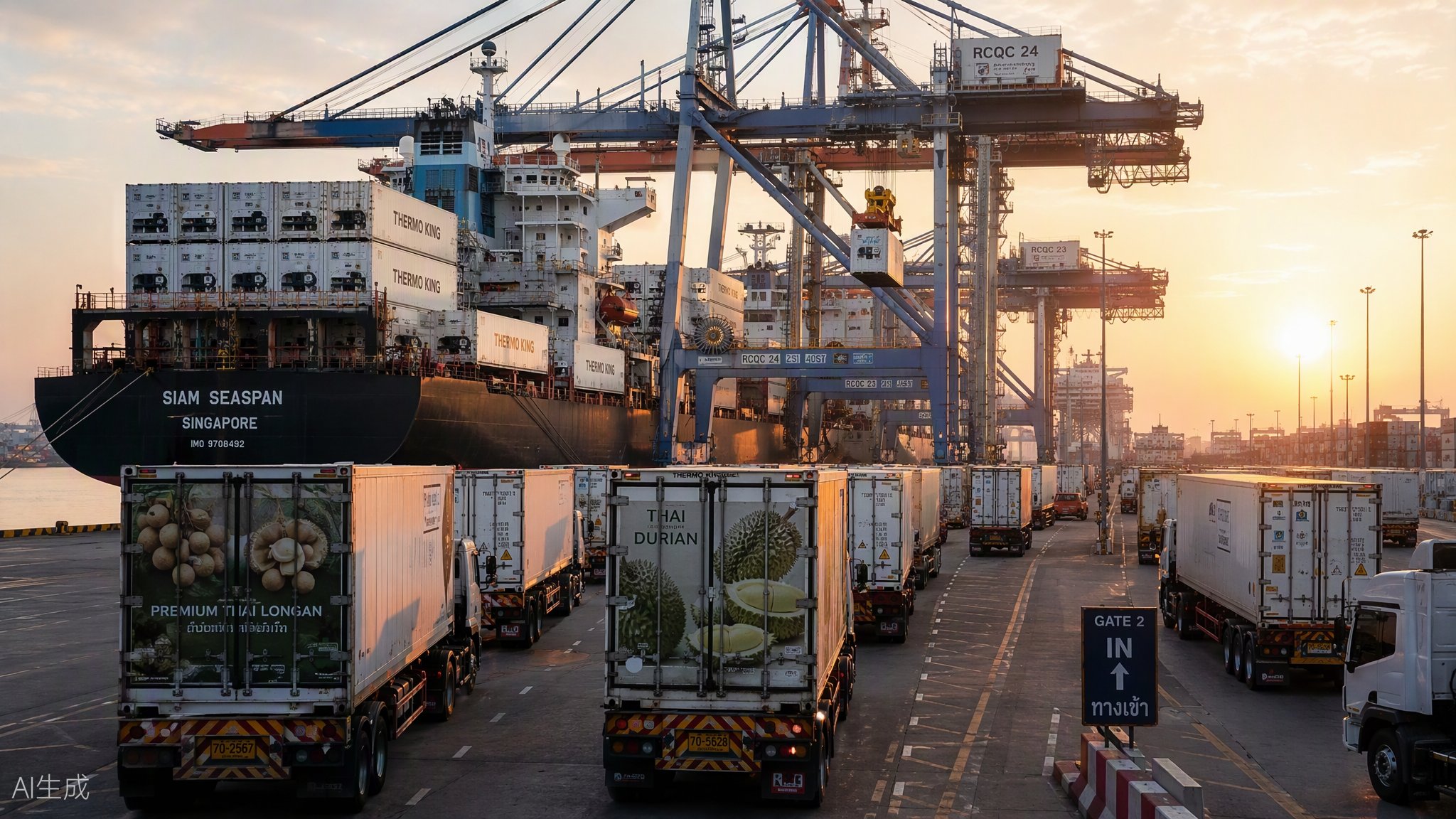
Peak-season Laem Chabang: the sea lane's 5–6 weekly sailings are the volume answer — and the first reefer slots to sell out.
3. Lane-by-Lane: Book It Now or Price It Later?#
Sea — the volume lane. The Qinzhou fruit express at 5–6 sailings/week and 3-day fastest transit is the only option that moves container-scale longan at ¥0.9–2.0/kg (lane cost model). Two booking rules from the trade: lock reefer slots 3–4 weeks out; expect peak-season ocean surcharges on the Thai express. If you want one December sailing to validate the lane before January volumes, that booking is being made this week.
Rail — the speed lane. Under-3-days orchard-to-SW-China with ±1 °C "one-box-through" service and winter frequency ramping toward daily; best for Kunming/Chengdu/Chongqing-bound loads and premium grades. October's +12.3% fruit growth says the corridor is scaling — but December-January peak weeks are precisely when the daily-frequency promise gets stress-tested, so treat late-December rail slots as perishable inventory and book by early January at the latest.
Road — the last resort that always works. 2–5 days door-to-door via Chongzuo/Pingxiang, 15-second smart-port clearance at the border (corridor analysis) — and CNY capacity constraints that price out all but top-grade mangosteen. Budget it as the insurance lane, not the plan.
Canal barge — the new variable. For Nanning-basin distribution, Qinzhou-landed fruit can now ride 134 km up the Pinglu Canal instead of trucking from a PRD port: toll-free through 31 Dec 2026, lock transit 70–80 minutes end-to-end with an operator wait-time commitment of ≤3 hours (first-month audit). Two honest caveats for your calendar: barge frequency is still ramping, and 1 Jan 2027 brings the RMB 1.0/GT/lockage tariff (≈¥25–75 per container — noise per box, but book 2027 rates with it included). December = pilot; January = negotiate.
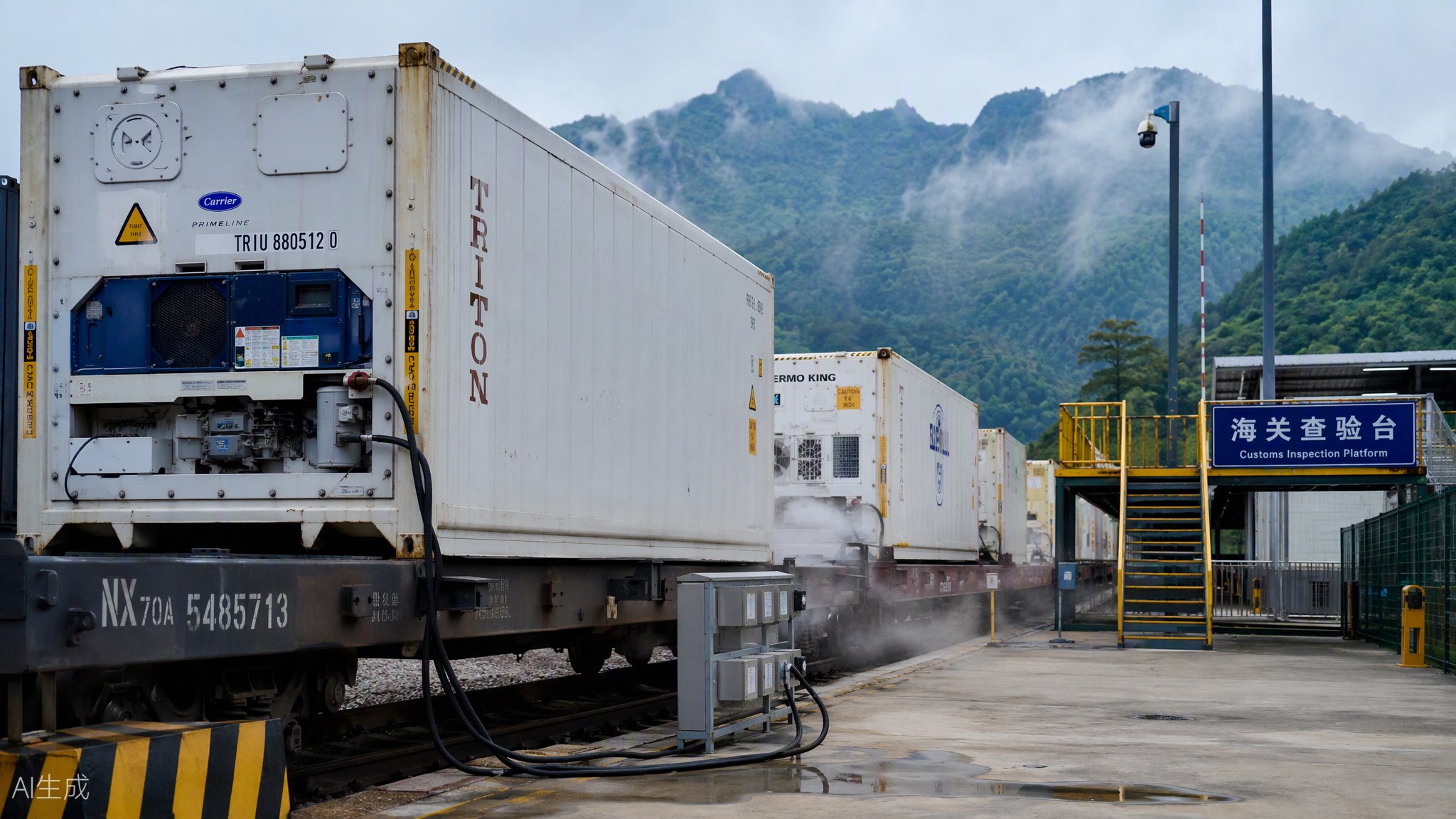
The rail lane's quiet build-up: 700+ new reefer boxes on the corridor this year, Jan–Aug fruit value +12.3% — capacity being added before the crunch, not after.
4. Your Week-by-Week Calendar (Nov → Feb)#
Our planning synthesis on the published numbers above — a working calendar, not a quote:
- Now → mid-Nov: price all four lanes per box (simulator); book December sea sailings + first January reefer allocations; verify your Form E paperwork chain (compliance checklist).
- Late Nov → Dec: run one validation shipment (sea, one 40HQ reefer); pilot the canal barge leg Qinzhou→Nanning while it is toll-free; confirm rail frequency for the last December train.
- Early Jan: final sea cutoff ≈ 8 Jan for last pre-CNY arrival; shift incremental volume to rail (book by early-mid Jan); road reserved for top-grade/crisis cargo.
- Mid-Jan → 3 Feb: sprint execution — monitor NE-monsoon delays (1–3 days on sea legs), keep 24-h Qinzhou clearance paperwork clean, and expect the Pingxiang 4-hour rail bypass to be priced at a premium.
FAQ#
Is it too late to set up a new lane for CNY 2027?#
No — but the window is measured in days, not weeks. A December sea validation sailing + January rail volumes is still achievable for a Nanning/SW-China importer. What is no longer available is the luxury of comparing lanes in December; the comparison has to happen this fortnight.
Does the 1 Jan 2027 canal toll change my fruit economics?#
Marginally. RMB 1.0/GT/lockage × 3 locks ≈ ¥25–75 per container — under ¥0.005/kg against a ¥11,000–25,000 pre-CNY reefer stack (the toll math). Reefer-slot scarcity and peak ocean surcharges are two orders of magnitude more important.
Longan or durian — which fights harder for slots this year?#
Durian. H1 rail volumes +56%, ¥23.4 bn Jan–Jul Thai orders, and one-in-three imported durians entering via Guangxi means durian shippers are pre-booking equipment at scale. Longan — winter-peak, volume-driven — depends on the same sea express but with more schedule flexibility. If you move both, book durian first.
What is the single cheapest insurance for January?#
The Pingxiang rail cold-chain bypass: fruit enters by road at the smart port, rides border-to-Nanning in ~4 hours on the March-launched train, skipping CNY road congestion. It will be priced at peak premium — but it exists, which is more than can be said for most years' plan B.
Methodology & Data Sources#
Planning dates are our arithmetic on published transit bands and stated booking lead times, labeled as such throughout. Market figures below are as reported on the dates given.
- CNY 2027 = Sat 6 Feb (eve 5 Feb); 11 days earlier than 2026 — gmw.cn / chinahighlights
- China–Laos rail cumulative >¥100.4 bn, >25,000 trains, >20.77 Mt, >24% annual growth; Jan–Aug 2026 fruit ¥5.26 bn, +12.3%; cumulative tropical fruit >¥16 bn; cold-chain train <3 days, ≈15% below road, spoilage −10% — Kunming CustomsS, 8 Oct 2026
- 700+ CRRCB Shijiazhuang reefer containers on the corridor; H1 durian 120,000 t, +56% — Modern Logistics NewsB, 13 Oct 2026
- Qinzhou 9 fruit lines, fastest 3 days from Thailand, 24-h fruit clearance; Guangxi ports >1.73 Mt / ¥26 bn ASEAN fruit Jan–Jul 2026; ~1-in-3 imported durians via Guangxi — guojiguoshuB / XinhuaA, Sep 2026
- Qinzhou automated terminal ~45,000 TEU projected for National Day week, 24/7 operation — People's Daily app, 8 Oct 2026
- Pingxiang rail port H1 fruit 2,276 TEU (+50.8%); "Pingxiang–Nanning" fruit train ~4 h, launched Mar 2026 — People's Guangxi / Xinhua, Sep–Oct 2026
- Thai fruit supply outlook ~+15% y/y; Thai durian Jan–Jul China orders ¥23.4 bn — regional trade press; 163.comB business desk, 20 Oct 2026
- Sea-lane booking lead 3–4 weeks; 5–6 weekly sailings; NE monsoon +1–3 days on South China Sea legs — Guangxi govt presserSs & trade reporting, Jun–Sep 2026; see our lane cost model
- Canal: toll-free to 31 Dec 2026; RMB 1.0/GT/lockage from 1 Jan 2027 (trial to 30 Sep 2031); lock transit 70–80 min; wait target ≤3 h — 桂发改价费规S〔2026〕533号; CLS.cnA field reporting, Oct 2026; see our 30-day audit
- Friendship Pass smart-port 15-s vehicle clearance — 21st Century Business HeraldA, Oct 2026; see our corridor analysis
Get a Tailored Logistics Assessment#
Run your own numbers in the cost simulator — or apply to be listed in the verified supplier directory. Reference values only; not a formal quote.