Public Beta · Reference parameters captured Nov 2026, while the Pinglu Canal is in water-trial/commissioning. Trade and capacity figures are city customs and media-reported data; the ~18% logistics saving is a reported estimate, not a measured tariff. Spotted a discrepancy? Tell us — this page exists to be challenged.
Key Numbers (Liuzhou Export Belt Ledger)#
| Metric | Reference value |
|---|---|
| Foreign trade, Jan–Sep 2026 | ¥40.51 bn, +28.1% y/y |
| Electric-vehicle exports | ¥5.25 bn, +279.4% y/y |
| Lithium-battery exports | ¥3.89 bn, +201.8% y/y |
| ASEAN-bound trade | ¥10.43 bn, +50.9% y/y; ASEAN markets: vehicles +272.3%, batteries +293% |
| Vehicle capacity base | 2.085M units/yr; cumulative 36M vehicles; NEV cumulative >4M |
| Parts localization | 300+ regulated parts firms; 63% local procurement rate |
| Cell capacity | 57.5 GWh (Gotion, REPT, Penghui lines) |
| Factory cadence | Smart-island changeover 15 min; automation 70–80% |
| Rail export front door | Liuzhou Railway Port customs site live, "arrive-and-load-direct"; Luorong base ~70,000 units/yr by rail |
| Corridor delta | Liujiang → canal → Beibu Gulf ~400 km shorter vs Pearl-River-Delta detour; logistics cost ~−18% (reported) |
| ASEAN production footprint | Wuling-led 17 partners in KD plants (Indonesia, Malaysia, Thailand) |
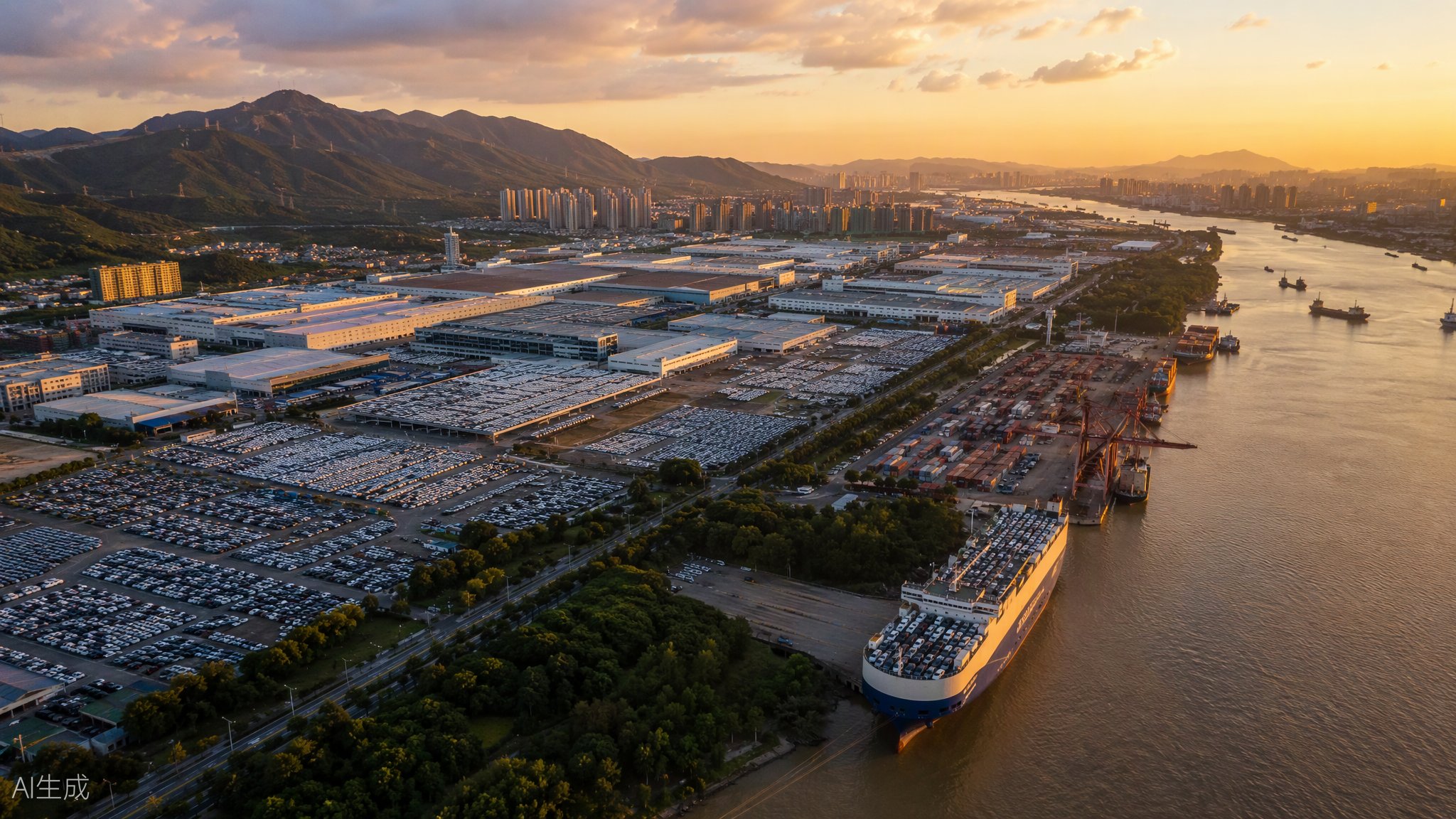
The belt in one frame: factory, holding yard, river port. Liuzhou's export geography is being redrawn from "truck east to the coast" to "raft south down the Liujiang and out through the canal."
1. The Export Engine: Reading the +279.4%#
Growth rates like +279.4% usually invite skepticism, so it is worth separating the numerator from the base. Liuzhou's EV export value of ¥5.25 bn in nine months sits on an industrial base that predates the surge: 2.085M units/yr of vehicle capacity, 36 million cumulative vehicles produced, and over 4 million cumulative NEVs — the arithmetic of a city that has been mass-producing small electric cars longer than most export peers. The 1–9月 totals (¥40.51 bn overall, +28.1%) say the surge is broadening, not narrowing: ASEAN-bound trade alone is ¥10.43 bn and growing at +50.9%, faster than any other regional leg.
The ASEAN detail matters for corridor planners. Within ASEAN markets, Liuzhou's complete-vehicle sales grew +272.3% and battery sales +293% — nearly symmetric growth that signals kit-and-component flows, not just finished-car shipments. That is precisely the cargo mix the canal corridor is built for: high-value, schedule-sensitive, containerizable.
2. The Belt Behind the Badge: 57.5 GWh and 63% Local Content#
A final-assembly town cannot sustain +279% export growth; a cluster can. Liuzhou's upstream ledger: 300+ regulated (规上) auto-parts enterprises achieving a 63% local procurement rate, and 57.5 GWh of power-cell capacity across three producer lines — Gotion, REPT and Penghui. The separator-and-materials layer of that battery cluster is already mapped in the battery-belt supply-chain analysis; what the export numbers add is proof that the cluster now sells abroad at industrial scale, not sample scale.
Factory-side cadence completes the picture. Intelligent production "islands" have cut model changeover to roughly 15 minutes, with automation rates of 70–80% on major lines — the flexibility that lets a plant swing between domestic SKUs and export SKUs (right-hand drive, regional certification, tropical battery packs) within a single shift pattern. For buyers, that is the difference between a supplier that can export and one that schedules exports.
3. The Corridor Math: 400 km Shorter, ~18% Cheaper (Reported)#
Liuzhou sits on the Liu River (柳江), a Xijiang tributary that already floated the city's industry before rail arrived. The canal changes the export geometry in one move: instead of trucking or railing cargo east and south around the Pearl River Delta, convoys raft down the Liu and Xijiang, pass the canal's locks, and meet ocean berths at Qinzhou. The reported delta is ~400 km shorter and ~18% lower logistics cost — a media-reported planning estimate, and we label it as such; it is directionally consistent with the 560+ km inland-leg saving measured in the Liuzhou–Thailand landed-cost study, and it will firm up as water-trial schedules publish.
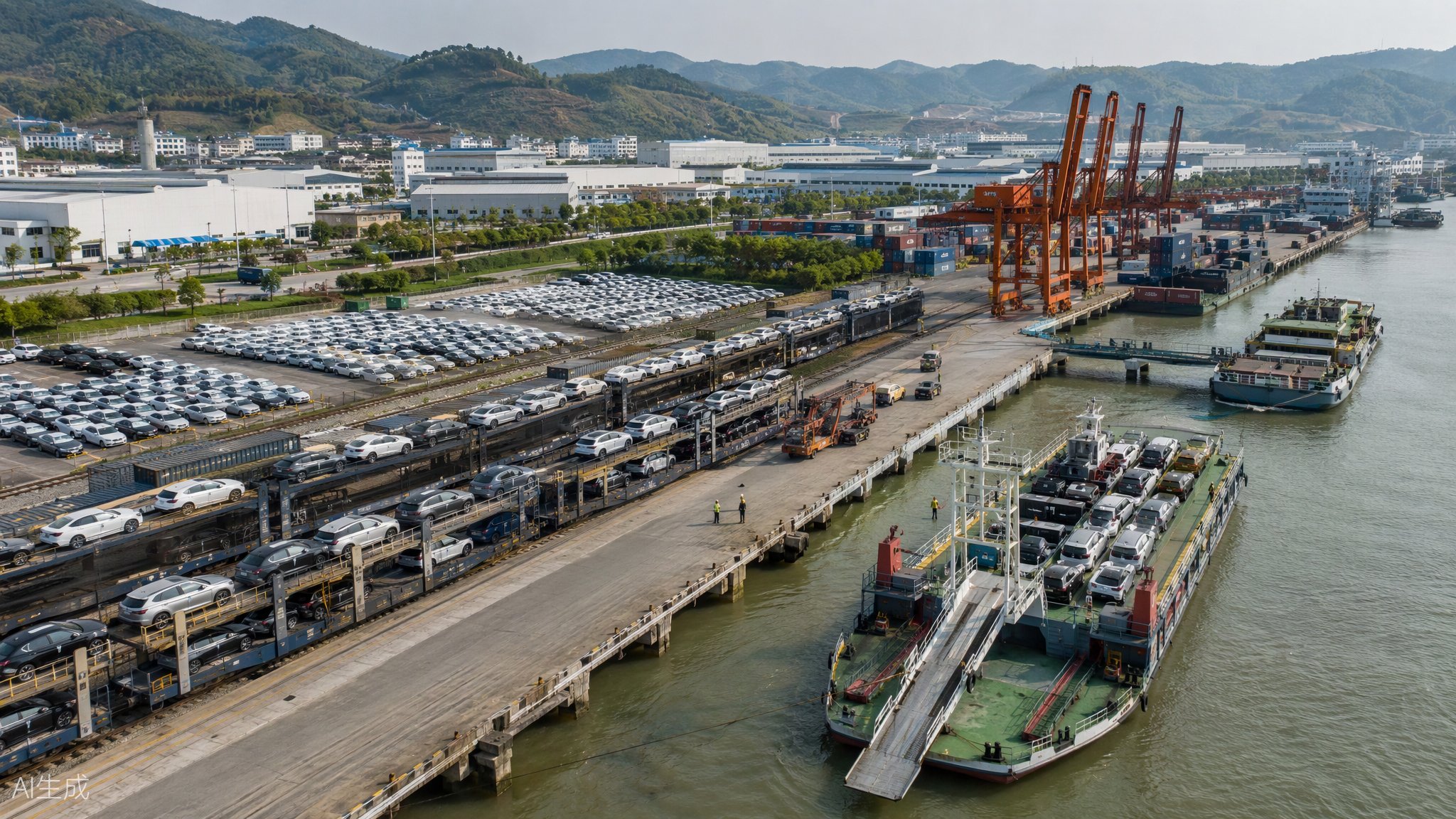
The front door: rail car-carrier wagons, river vehicle barges and container cranes sharing one hub — the "arrive-and-load-direct" customs model removes the warehouse stop between factory and berth.
For vehicle and battery exporters the operational consequence is time-to-berth. Under the old detour, a Liuzhou-built car spent days in transit and handovers before it was export cargo; on the canal corridor it becomes documented export cargo at the river port of origin, which is what unlocks "抵港直装" — arrive-and-load-direct — at the Qinzhou sea side. Run the origin-to-berth math for your own cargo in the cost simulator, which already prices the Liuzhou origin.
4. Rail Plus Canal: The Luorong Valve#
Rail remains the volume valve for finished vehicles. The Luorong commodity-car base ships ~70,000 units/yr onto the network, and Liuzhou Railway Port's new customs supervision site means those wagons clear export formalities in-city rather than at the coast — the rail-side twin of the canal's river-port customs model. The two modes are complements, not rivals: rail owns the long-hinterland and high-frequency slots (the rail–canal intermodal review covers the node design), while the canal absorbs the marginal container and breakbulk flow — and gives the belt a weather-proof alternative when rail capacity tightens ahead of CNY peaks.
5. The Pull From ASEAN: KD Plants as Order Flow#
The demand side of the ledger is less visible but arguably more durable. SAIC-GM-Wuling has carried 17 supply-chain partners into knock-down plants across Indonesia, Malaysia and Thailand — a footprint that converts "China-made exports" into a two-way industrial system: kits, components, battery packs and tooling flow south; market intelligence and localization requirements flow back. Every KD line in Rayong or Bekasi is a standing order for Liuzhou's belt, and the canal corridor is the shortest documented water path between those two points. The Thailand leg's port-level economics are already priced in the Qinzhou–Laem Chabang ro-ro breakdown.
FAQ#
Are the +279.4% / +201.8% figures official?#
They are city customs figures as reported by regional media in October–November 2026. We reproduce them with source attribution and treat them as directional: nine-month value growth on a fast-rising but still-maturing export base.
Is the ~18% logistics saving a measured tariff?#
No. It is a reported estimate for the Liujiang → canal → Beibu Gulf routing versus the Pearl-River-Delta detour. No independent tariff schedule exists yet while the canal is in commissioning; we publish the number with its label and expect it to firm up with published schedules and shipper data in 2027.
Does the canal carry finished vehicles today?#
The vehicle flows documented to date run by rail (Luorong, ~70,000 units/yr) and by ro-ro from Qinzhou (single sailings up to 2,727 vehicles). Canal convoys for breakbulk and containers are in commissioning; vehicle-raffting downstream is a 2027 watch item, not a current service claim.
What should an ASEAN buyer do with this?#
Treat Liuzhou as a two-mode supplier base: confirm SKU flexibility (15-minute changeover lines take small export batches), and quote both rail and canal routings through the simulator before committing 2027 volumes. Suppliers with KD experience in your market (Wuling's 17-partner footprint) will quote landed, not FOB-port-east.
Methodology & Data Sources#
Trade values, growth rates, capacity, localization, cell-capacity, changeover, rail-base and KD-footprint figures are Liuzhou city customs / industry figures as reported by regional media (Toutiao aggregation of the original city reports, Oct–Nov 2026). The ~400 km / ~18% corridor delta is a media-reported planning estimate and is labeled as such throughout. Corridor context cross-links to prior site coverage. No unsourced freight rates are published per this site's sourcing rules.
- Jan–Sep 2026 foreign trade ¥40.51 bn (+28.1%); EV exports ¥5.25 bn (+279.4%); battery exports ¥3.89 bn (+201.8%); ASEAN trade ¥10.43 bn (+50.9%); ASEAN vehicles +272.3%, batteries +293%; capacity 2.085M/yr, cumulative 36M, NEV >4M; 300+ parts firms, 63% local content; 57.5 GWh (Gotion/REPT/Penghui); 15-min changeover, 70–80% automation — Liuzhou customs/industry data, via regional media, Oct–Nov 2026
- Luorong vehicle base ~70,000 units/yr by rail; Liuzhou Railway Port customs supervision site, "arrive-and-load-direct" — regional media, Oct–Nov 2026
- Wuling-led 17-partner KD footprint in Indonesia, Malaysia, Thailand — regional media, Oct–Nov 2026
- Corridor context: Liujiang → canal → Beibu Gulf ~400 km shorter, ~−18% logistics cost (reported estimate); ro-ro record and berth economics — Liuzhou–Thailand landed cost; rail–canal node design — rail–canal intermodal review; battery cluster — battery-belt analysis; canal commissioning status — 30-day operations audit
Get a Tailored Logistics Assessment#
Run your cargo through the cost simulator — Liuzhou origin priced for both rail and canal routings, lockage included — or apply to be listed in the verified supplier directory. Reference values only; not a formal quote.