Public Beta · Reference parameters captured Oct–Nov 2026. Route and throughput figures are from People's Daily Overseas Edition, China News Service, CCTV field reporting and the Belt & Road Portal; shipper volumes are company statements. The 18–30% cost band is a reported range, not a measured tariff. Spotted a discrepancy? Tell us — this page exists to be challenged.
Key Numbers (Bauxite Gate Ledger)#
| Metric | Reference value |
|---|---|
| First "sea-to-river" cargo | 16 Sep 2026: Guanfeng 1800 / Guanfeng 0089, Australian bauxite, Qinzhou Dalantun → canal → Nanning Port → Baise Xiangzhou |
| First arrival at Baise | 21 Sep 2026: Tongsheng 5678 / Tongsheng 5566 at Tiandong Xiangzhou, after Nanning transshipment to 2,000-t vessels |
| Route repricing | ~650 km vs ~1,200 km (–560 km); 5–7 days vs 12–15; comprehensive logistics cost −18% to −30% (reported range) |
| Anchor shipper | Tiandong Jinxin Chemical: 500,000 t in 2026 via canal, 2M t target 2027 (company statement); 1-year contract with Beibu Gulf Port Group |
| Nanning Port September | 668,400 t, +145% y/y; 5,000-t → 1,000/2,000-t water transshipment at Liujing / Niubay |
| Upstream fleet | Guinea-origin bauxite also arriving via Qinzhou → canal → Nanning (CCTV-documented) |
| The bottleneck | Jinjitan lock (8 km upstream of Long'an), grade III, designed 1,000 t, saturated; first-month queue 21 h; 4 locks total between Nanning and Baise (Yongning, Laokou, Jinjitan, Yuliang) |
| Processing proof in Nanning's orbit | Long'an Hetai New Materials: African bauxite + Australian coal in; aluminum products out, cement clinker back to Africa |
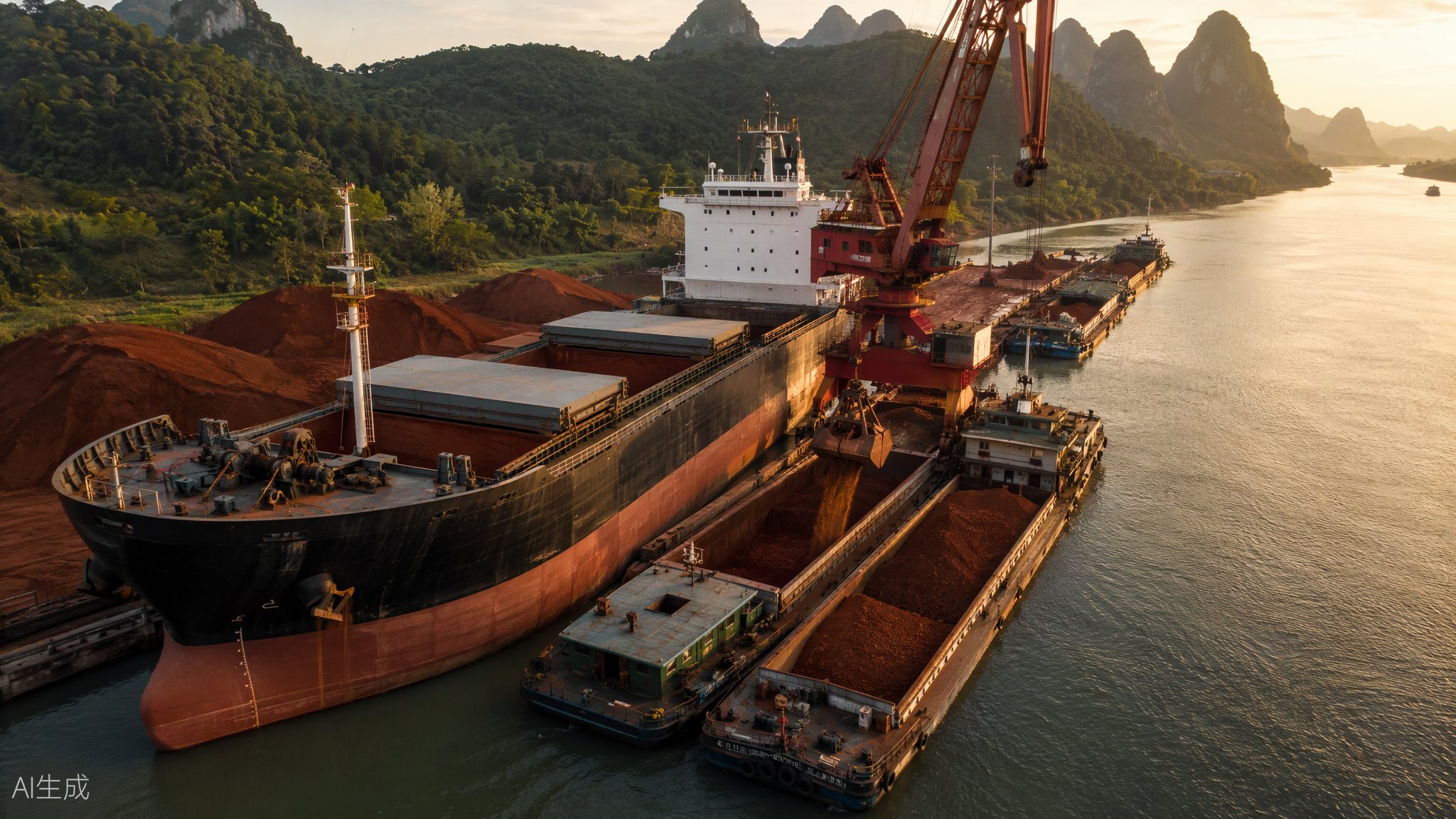
The valve in one frame: ocean bulk meets river convoy at Nanning. The reddish pile on the quay is Guangxi's aluminum belt arriving by its newest route.
1. Why the First Cargo Was Bauxite#
Canal opening days are stage-managed; the choice of debut cargo is a policy signal. Guangxi chose bauxite. That is no accident: the province runs a hundred-billion-yuan aluminum industry whose upstream has always been hostage to geography — ore lands on the coast and then faces a 1,200-km, 12-to-15-day detour through the Pearl River Delta before it can feed the smelters of Baise and the processing belt around Tiandong. The opening-day scene reversed the arrow: Guanfeng 1800 and Guanfeng 0089 cleared Qinzhou's Dalantun area, rode the canal 134 km north, and handed the ore to Nanning Port — from which the Youjiang, not the Pearl River, does the delivering.
The precedent this sets is bigger than one shipment. Ore is the heaviest, lowest-margin, most logistics-dominated input in the entire aluminum cost stack; whichever corridor wins the ore contract effectively wins the cluster. The canal's debut cargo was Guangxi telling its smelters which corridor the province intends to win on.
2. Nanning Port, the Valve — and What September Proved#
Nanning's role in this belt is frequently misread. It does not smelt at scale; it transships. The mechanic is a two-step water handover: 5,000-t sea-river convoys arrive off the canal, and their cargo is clamshelled across into 1,000–2,000-t Youjiang vessels at the Liujing and Niubay operating areas — the same Liujing that, per the first-month industrial ledger, now runs a 40-t gantry crane at 800 t/h after its 300 t/h upgrade. That crane was effectively purchased by cargo like this: sticky, dusty, continuous bulk.
September's numbers say the valve is already load-bearing: 668,400 t through Nanning Port, +145% y/y, roughly "two months of volume in one." CCTV's field reporting documented Guinea-origin bauxite making the same Qinzhou → canal → Nanning path alongside the Australian lots — the valve is already multi-origin, which matters for buyers hedging single-country ore exposure. For the corridor-wide context of how this transshipment layer was built, see the Baise aluminum-wheels case.
3. The Shipper Arithmetic: 500,000 t, Then 2 Million#
The cleanest demand signal in this story is contractual. Tiandong Jinxin Chemical — the cargo owner behind the first arrivals — stated publicly that it plans to move 500,000 t of imported ore through the canal in 2026 and has set a 2M t target for 2027, with a one-year transport contract signed with Beibu Gulf Port Group. Read that structure carefully: it is not a volume commitment, it is a measurement commitment. One year of documented runs through both wet and dry seasons, then decide.
For anyone pricing 2027 cargo on this corridor, Jinxin's contract is the template to watch: the 500k → 2M step-up will only trigger if the four-lock Youjiang run holds schedule through a full hydrological year. Shipper statements like these are labeled as such on this site; the route economics underneath them (−560 km, −18% to −30% comprehensive cost, reported by People's Daily Overseas Edition citing Guangxi MSA) are the part you can take to a model. Run the origin-to-berth math for your own ore or product in the cost simulator.
4. The Honest Constraint: Four Locks and a 21-Hour Queue#
No credible corridor analysis skips the bottleneck, and this one is specific. Between Nanning and Baise's Xiangzhou berth, every convoy must climb the Youjiang through four locks — Yongning, Laokou, Jinjitan and Yuliang — and the third one is the pinch. Jinjitan, 8 km upstream of Long'an, is a grade-III structure designed for 1,000-t vessels whose capacity, in the words of CCTV's reporting, is already saturated. In the first month it held one Nanning-bound barge owner for 21 hours before clearing the chamber.
Two implications. First, the near-term ceiling on Jinxin's 2M t ambition is set not by the canal but by Youjiang lock cadence — until the planned right-river navigation upgrade and Baise-hydro-junction works deliver additional chamber capacity, schedule risk accumulates at Jinjitan, and shippers should price it. Second, peak-season behavior will bifurcate: time-insensitive ore absorbs the queue; time-sensitive cargo will pay for rail or road around it, which is exactly how a two-mode belt should price itself. This site's standing guidance on canal-side lock cadence and the 2027 metered lockage fee is in the lockage guide and the 30-day operations audit.
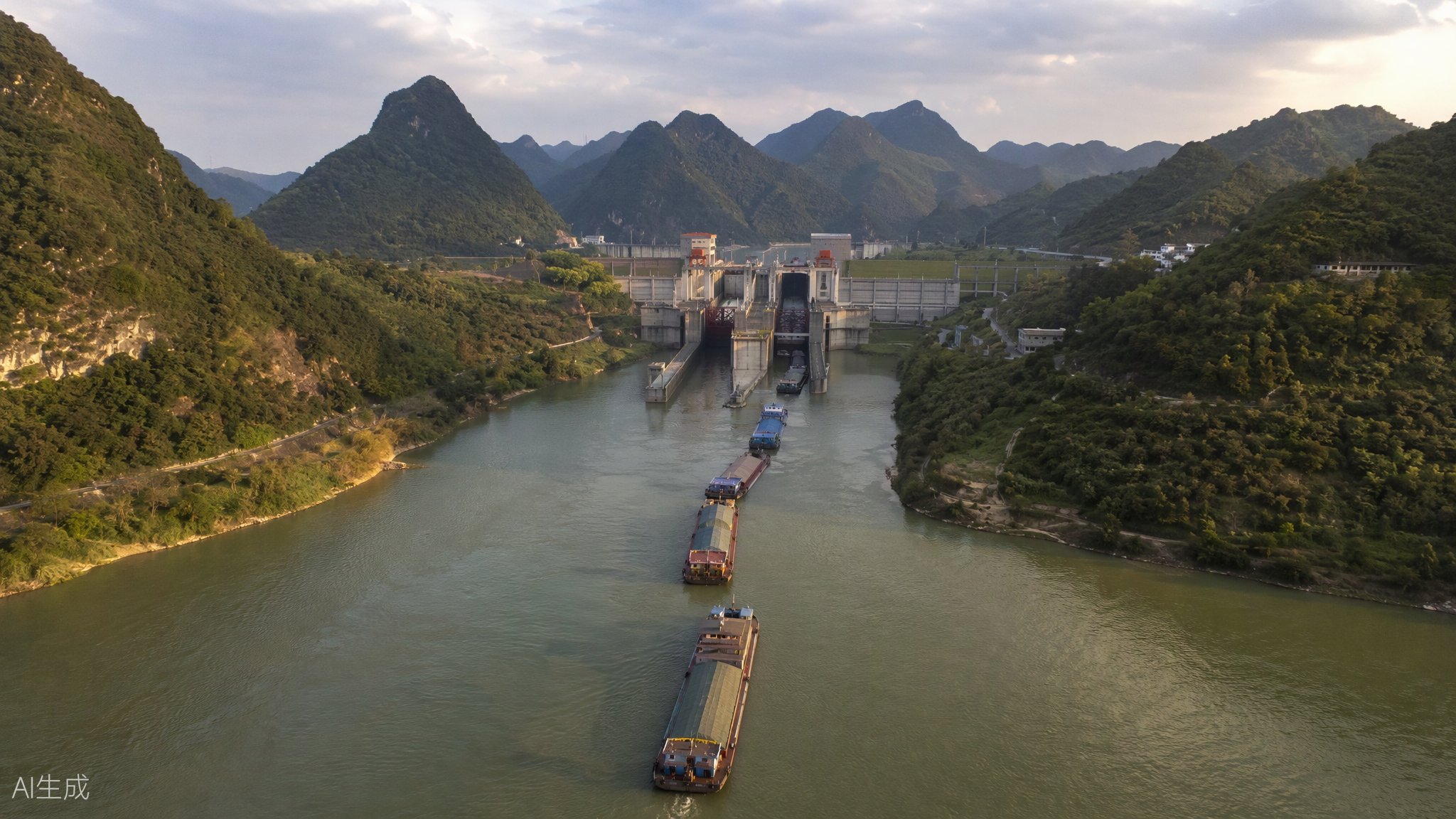
The real gate: a grade-III lock on the Youjiang, designed for 1,000-t vessels and already saturated. Until the right-river upgrade adds chamber capacity, this — not the canal — sets the ceiling on bauxite convoys to Baise.
5. What "Nanning Aluminum Cluster" Actually Means#
Prospective buyers reading headlines may picture smelters in Nanning; the cluster's real geometry is three layers, and the canal upgraded all three. The valve layer is Nanning Port itself — transshipment, storage, and the emerging spot-trade function that forms wherever bulk changes hands and mode. The processing layer sits in Nanning's administrative orbit: at Long'an on the upper Youjiang, the Hetai New Materials base is already running an import-processing loop its chief engineer describes plainly — African bauxite and Australian coal in; aluminum products out; cement clinker exported back to Africa — with the canal added, in his words, as "a new channel that strengthens supply-chain security." The smelting layer remains downstream in Baise, whose officials have publicly framed the post-canal playbook: expand bauxite, recycled-aluminum and manganese imports by water, push high-end aluminum products out the same gate, and build a pan-aluminum-parts advanced manufacturing base.
Nanning's upside is in the first two layers: every tonne that changes holds at the valve generates handling, finance, inspection and trading margin in the capital — and every wet-season queue at Jinjitan makes river-side storage at Nanning more valuable, not less. That is the outlook in one sentence: the cluster's center of transaction gravity moves to the valve; its center of mass stays on the Youjiang.
FAQ#
Is Australian bauxite now the corridor's main ore flow?#
It is the documented opening flow, with Guinea-origin lots confirmed on the same Qinzhou → canal → Nanning path within the first month. Treat the mix as multi-origin from the start — that is precisely the supply-security argument shippers are making publicly.
Does the 18–30% cost saving apply to my cargo?#
The band is a reported range for the Baise ore route versus the Pearl-River-Delta detour, sourced to People's Daily Overseas Edition citing Guangxi MSA. Your cargo's saving depends on origin, seasonality and lock exposure — model it in the simulator rather than applying the headline band.
What is the realistic 2027 ceiling on canal bauxite volumes?#
The declared intent is 2M t from the anchor shipper alone, but the binding constraint is the four-lock Youjiang run, led by the saturated Jinjitan chamber. Watch the right-river navigation upgrade and Baise-hydro-junction timelines; they, not canal capacity, set the ceiling.
Is Nanning becoming a smelting base?#
No evidence of that in current reporting. The capital's role is transshipment, storage, trade and — in its Long'an orbit — processing loops like Hetai's. Smelting capacity remains concentrated in Baise.
Methodology & Data Sources#
Opening-day cargo, first-arrival, route mileage/time and the 18–30% cost band are from People's Daily Overseas Edition (23 Sep 2026, citing Guangxi MSA) and China News Service (16 Sep 2026); September Nanning Port throughput, multi-origin ore documentation and the Jinjitan queue are from CCTV field reporting (republished via Guangxi News Network and 163.com, 13–18 Oct 2026); shipper volumes, contract structure and the 2027 target are Jinxin Chemical statements via China Water Transport News (republished via Sohu, 22 Sep 2026); the Long'an Hetai processing loop and the belt-and-road corridor context are from the Belt & Road Portal (16 Sep 2026, Xinhua-sourced). No unsourced freight rates are published per this site's sourcing rules.
- Opening-day "sea-to-river" scene (Guanfeng 1800 / Guanfeng 0089, Australian bauxite, Dalantun → Nanning → Baise) — China News ServiceA, 16 Sep 2026
- First arrival at Tiandong Xiangzhou 21 Sep; Nanning transshipment to 2,000-t vessels; ~650 km / 5–7 d vs ~1,200 km / 12–15 d; cost −18% to −30% — People's Daily Overseas Edition, 23 Sep 2026
- Jinxin Chemical: 500,000 t 2026 plan, 2M t 2027 target, one-year contract with Beibu Gulf Port GroupB — China Water Transport News via SohuB, 22 Sep 2026; contract cross-confirmed by CCTVA field reporting, 18 Oct 2026
- Nanning Port Sept throughput 668,400 t (+145% y/y); 5,000→1,000-t water transshipment; Guinea-origin ore on same path — CCTV "Vitality China" field report, 13 Oct 2026
- Jinjitan lock (grade III, 1,000-t design, saturated; 21-h queue; four-lock Youjiang run) — CCTV via Guangxi News Network, 18 Oct 2026
- Long'an Hetai New Materials loop ("African bauxite + Australian coal; products out, clinker to Africa"; canal "a new channel") — Belt & Road Portal / XinhuaA, 16 Sep 2026
Get a Tailored Logistics Assessment#
Move your ore, processed aluminum or equipment through the cost simulator — Nanning and Baise origins both priced, lockage included — or apply to be listed in the verified supplier directory. Reference values only; not a formal quote.