Public Beta · Reference parameters captured Nov 2026. Transit tiers are industry planning benchmarks unless individually sourced; per this site's rules, no unsourced dollar rates are published. Spotted a discrepancy? Tell us — this page exists to be challenged.
The Three Great Arteries of Southwest China#
Dispatch cargo from Chongqing, Chengdu, Guiyang or the Guangxi river ports and you are choosing between three structurally different corridors:
- Pinglu Canal river-sea (southbound waterway): inland river ports (Nanning, Guigang, Liuzhou, Baise) → Pinglu Canal's three cascading locks → Qinzhou/Beibu Gulf → ASEAN destination ports (Haiphong, Bangkok, Jakarta, Port Klang).
- ILSTC rail-sea intermodal (southbound rail-ocean): the Western Land–Sea New Corridor's scheduled container trains from inland rail hubs (Chongqing Tuanjiecun, Chengdu, Guiyang) direct to Qinzhou port's rail station → ocean vessel transfer.
- China-Europe Railway Express (westbound trans-Eurasian rail): inland hubs → Alashankou/Khorgos → Central Asia → Russia/Belarus → Poland/Germany.
They are not competitors so much as different tools. The matrix:
| Corridor | Best suited for | Transit benchmark (planning tier) | Cost position (relative) | Core constraint |
|---|---|---|---|---|
| Pinglu river-sea (this site's scope) | Bulk commodities, aluminum, sugar, auto parts, steel | Short inland barge leg + ASEAN sea transit (lane-dependent; e.g. Qinzhou–Malaysia direct loops 3–4 days) | Lowest — official corridor saving estimate 18–30% vs road/rail; industrial cases ≈30%/t | Lock queue discipline (full transit 70–80 min through 3 locks; queue target ≤3 h), weather/draft |
| ILSTC rail-sea | EV batteries, precision electronics, time-sensitive auto CKD | ≈2 days rail Chongqing→Qinzhou, then sea leg | Moderate — above barge, below pure air/road rush | Rail terminal drayage, port-yard dwell, higher tariff than barging |
| China-Europe Express | High-value electronics, medical, e-commerce | 12–18 days to Western Europe vs 35–45 days by sea | High — commonly quoted 3–4× ocean freight, far below air | Gauge-changing borders (Alashankou/Khorgos), geopolitical/transit risk |
Transit and cost tiers are industry planning benchmarks for orientation, not quotes; individually sourced figures are footnoted in the methodology section.
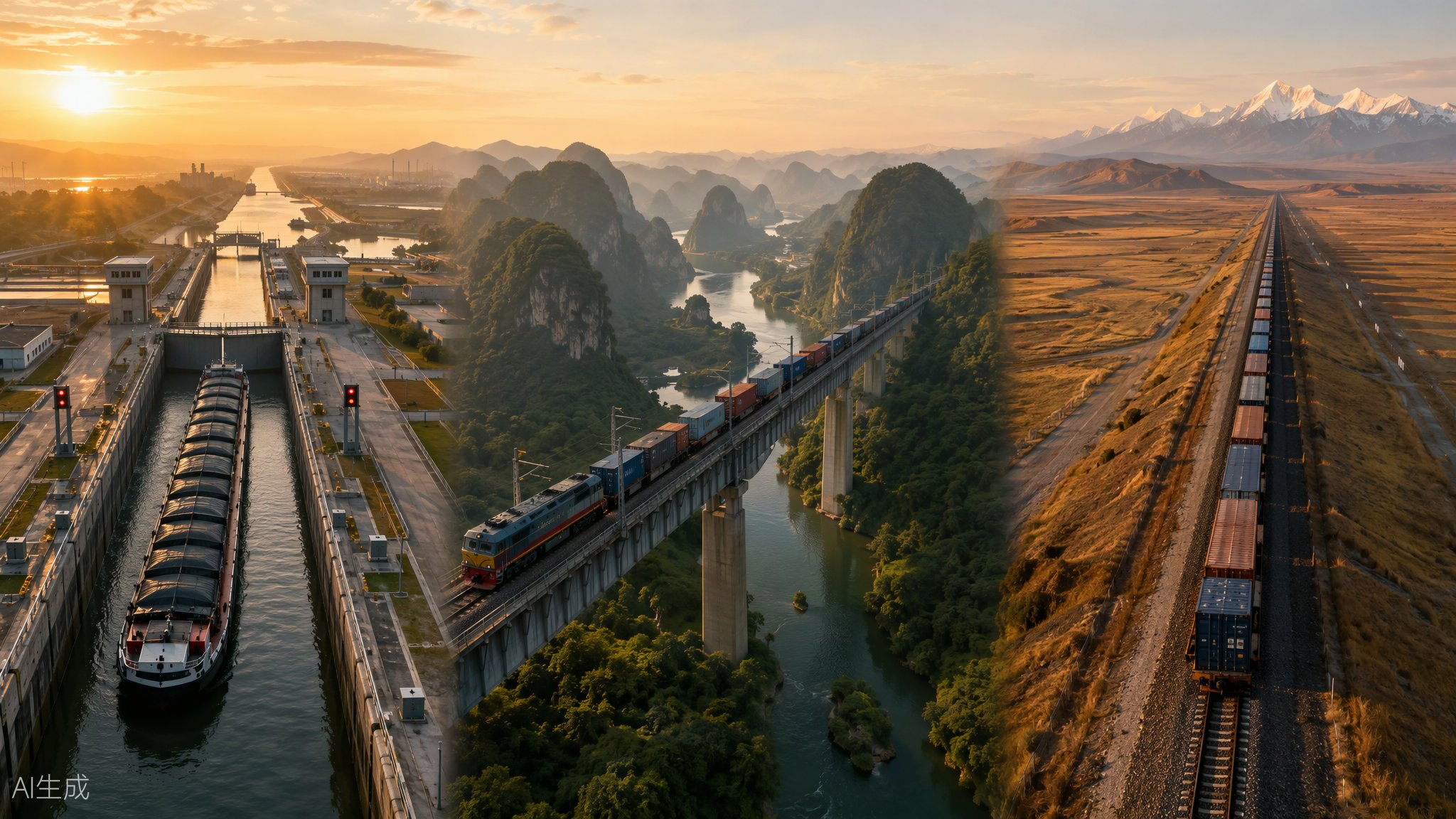
Three arteries, three physics: water moves tonnage cheapest, scheduled rail moves time-sensitive boxes predictably, and trans-Eurasian rail trades cost for a 12–18-day Europe clock.
1. Pinglu Canal River-Sea — The Waterway We Model#
Routing: Xijiang-basin river ports → Pinglu Canal (Madao, Qishi, Qingnian locks, 134.2 km, 65 m of lift) → Qinzhou → direct Beibu Gulf feeders.
The ROI profile: the lowest freight cost per tonne-kilometre of the three, by a wide margin. This is the corridor's official geometry — roughly 560 km shorter than the Pearl River detour, with a published 18–30% saving versus road/rail — and it is now corroborated at plant level: Baise aluminum producers report ≈30% cheaper inbound bulk freight by canal barge (industrial case). Ideal for bulk, metals, sugar, auto parts and any cargo where cost outranks days.
The trade-offs, stated honestly: canal capacity is metered by locks. Full transit through all three chambers runs 70–80 minutes when chambers cycle on design; the operating target for queue time is ≤3 hours, and early operations ran 7–8 lockages a day against a design of ~20 — headroom exists but peak-season queues are real (30-day operations audit). From 1 Jan 2027 a metered lockage fee applies (RMB 1.0/GT/lockage — noise-level at bulk volumes, but it belongs in quotes) (lockage guide).
2. ILSTC Rail-Sea — The Scheduled Middle Path#
Routing: inland rail dry ports → direct trains to Qinzhou port rail station → quay-side transfer to ocean vessels.
The ROI profile: ≈2 days Chongqing→Qinzhou by rail, then the same ASEAN sea legs as the waterway corridor. Rail-sea wins when cargo is time-sensitive but not air-sensitive: EV batteries, precision electronics, auto CKD kits. It also side-steps river draft and lock-queue exposure entirely, with standardized single-window documentation across the corridor.
The trade-off: the rail leg prices above barge freight — you are buying schedule certainty and border-predictability with a moderate premium, and terminal drayage plus yard dwell still eat hours at both ends.
3. China-Europe Railway Express — The Clock, Not the Price#
Routing: inland hubs → Alashankou/Khorgos → Central Asia → Belarus/Poland → Duisburg and beyond.
The ROI profile: 12–18 days to Western Europe versus 35–45 days by ocean — at a freight level commonly quoted at 3–4× ocean (and a fraction of air). This is the corridor for high-value, deadline-driven cargo: electronics launches, medical devices, e-commerce replenishment.
The trade-off: cost and friction. Gauge-changing at the Kazakh border, transit-state geopolitics, and sanction-screening complexity all sit in the lane's risk column. When ocean rates spike or Europe lead-times compress, the Express is the pressure valve; it is not the default.
4. The Relay Play: ASEAN → Chongqing → Europe#
These corridors are composable, and the most sophisticated users treat Qinzhou as a cross-dock. One proven pattern: tropical commodities or components arrive from Vietnam/Thailand by sea feeder into Qinzhou; containers swing onto ILSTC rail to Chongqing; goods are processed or cross-docked, then forward onto the China-Europe Express to European distribution centers. The corridor pieces interlock because Qinzhou's river, rail and quay terminals share one customs regime — the same "fewer touches" logic documented across this site's lane coverage (corridor explainer).
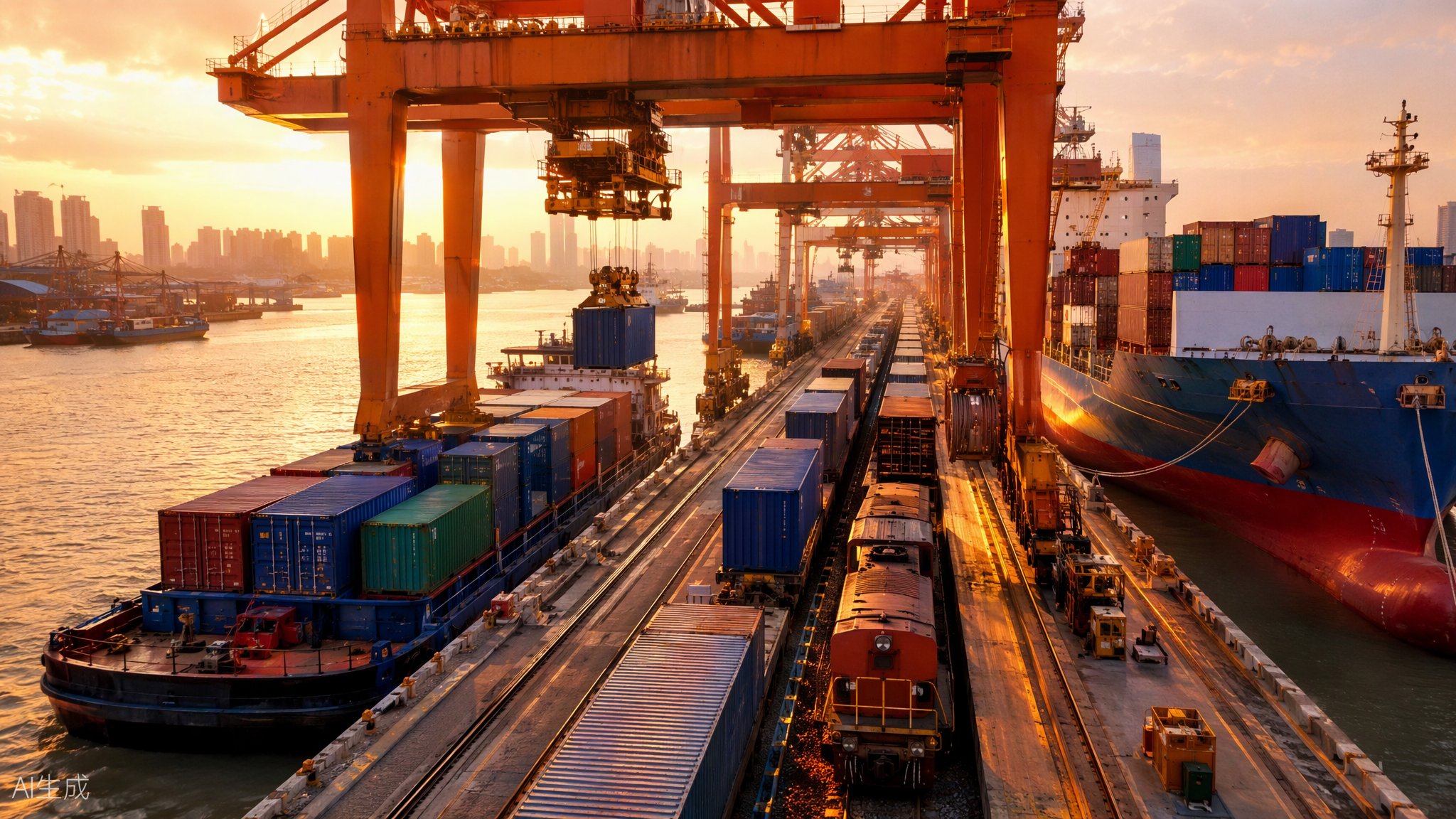
The relay: river, rail and ocean meet at one quay in Qinzhou. Choosing a corridor is a per-leg decision — the strongest networks compose all three.
How to Choose: A 60-Second Decision Path#
- Cargo is heavy, bulky, or cost-dominated (bulk, metals, sugar, parts) → Pinglu river-sea. Lowest cost position; validate lock-queue windows in peak weeks.
- Cargo is time-sensitive but schedule-driven (batteries, electronics, CKD) → ILSTC rail-sea. Pay the rail premium for certainty.
- Cargo is Europe-bound, high-value, deadline-driven → China-Europe Express when the clock justifies 3–4× ocean.
- Cargo does more than one of these → relay at Qinzhou. Model the water legs here; source rail legs from operators directly.
FAQ#
Does PingluCanal.org's calculator cover the rail corridors too?#
No — deliberately. We model the river-sea corridor exclusively, which is what allows the calculator to be precise about it. Rail tariffs and border procedures live in different systems; for rail legs we recommend requesting operator quotes directly.
Is the Pinglu Canal a replacement for the China-Europe Railway Express?#
No — different directions and different economics. The canal serves southbound ASEAN trade (where water cost dominates); the Express serves westbound Europe time-sensitivity (where the 12–18-day clock dominates). They are complements, not substitutes.
What about dry-season river draft limits on the canal?#
River draft is a real planning constraint on the upstream Xijiang legs in dry months; vessel loading plans should be re-confirmed seasonally. The canal's three-lock section itself is engineered to class specifications — the binding variable is usually the upstream river, not the canal.
Where do the transit and cost tiers in the matrix come from?#
Individually: the canal figures are official and sourced below; the Baise ≈30%/t saving is a company statement; rail and Eurasian tiers are industry planning benchmarks, marked as such. Nothing in the matrix is a quote.
Methodology & Data Sources#
This is a strategy and boundary-setting piece: canal-side figures use this site's sourced data, rail-side tiers are industry planning benchmarks labeled as such, and no unsourced dollar rates are published per site rules. Where planning arithmetic appears, it is flagged.
- Canal geometry: 134.2 km, 65 m lift, three locks; ≈560 km shorter than Pearl River detour; corridor saving estimate 18–30% vs road/rail — Guangxi government press conferenceS, Sep 2026; route explainer
- Lock operations: full transit 70–80 min; queue target ≤3 h; 7–8 vs ~20 design lockages/day (early operations) — 30-day operations audit, Oct 2026
- Lockage fee RMB 1.0/GT/lockage from 1 Jan 2027; free to 31 Dec 2026 — 桂发改价费规S〔2026〕533号; lockage guide
- Industrial corroboration of canal freight saving ≈30%/t (coal/alumina inbound) — China News ServiceA corridor interview, 29 Oct 2026; Baise case
- ASEAN sea-leg examples: Qinzhou–Malaysia direct loops 3–4 days (Kuantan service) — China DailyA (Guangxi), 31 Jan 2026; see Port Klang framework
- ILSTC rail-sea ≈2 days Chongqing→Qinzhou; China-Europe Express 12–18 days to Western Europe vs 35–45 days ocean; 3–4× ocean freight — industry planning benchmarks, Nov 2026 (orientation tiers; re-verify at booking)
Get a Tailored Logistics Assessment#
Model your river-sea legs in the cost simulator — ASEAN corridor, lockage included — or apply to be listed in the verified supplier directory. Reference values only; not a formal quote.