Public Beta · Reference parameters captured Oct–Nov 2026. Border-clearance and fruit figures are from published reporting and government disclosures; rates are planning context, not quotes — verify at booking. Spotted a discrepancy? Tell us — this page exists to be challenged.
Key Numbers (Friendship Pass Smart Port)#
| Metric | Reference value |
|---|---|
| Battery swap time | 1.9 min per IGV; automatic request at <30% charge |
| Swap station capacity | 2,500 kVA; one station covers 50 IGVs round-the-clock |
| IGV daily operation | 22 h/day vs 8–12 h human-staffed limit |
| Automated container bay | 5 fixed cranes × 24 TEU/h = 2,880 TEU/day; 20-TEU temporary stacking |
| Truck turnover | Unmanned 3–4× human; fleet rotation 9 h → 3 h |
| Single customs declaration | 10 min → under 3 min |
| Truck clearance check | 1 min → 15 sec (−75%) for Vietnamese-driver and unmanned vehicles, since 1 Jan 2026 |
| Lab quarantine | 3–5 days → 36 h; RPA replaces 4–5 sampling staff, 24 h |
| Overall clearance efficiency | +40%; parking-bay turnover +35%; berth waiting −20% |
| Daily window | Smart port 24 h vs traditional gate 08:00–19:00 → ~+13 h/day |
| Design capacity | >4,000 vehicle crossings/day; >2× current capacity when fully on line |
| Investment / timeline | ¥1.06 bn smart-port program; China segment fully tested, Vietnam segment due Oct 2027 |
| Trade through the pass | 2025 crossings topped 1 million vehicles (first time); Jan–Aug 2026 value ¥513.6 bn, +31.2% y/y |
| Fruit ledger | Jan–Aug 2026 durian ¥17.61 bn / 620,000 t; ~2 in 5 imported durians clear here; legacy fresh-cargo loss ~5% |
| Electronics ledger | ~70% of export value electronic intermediates; Bắc Ninh/Bắc Giang "N+1" next-day supply cadence |
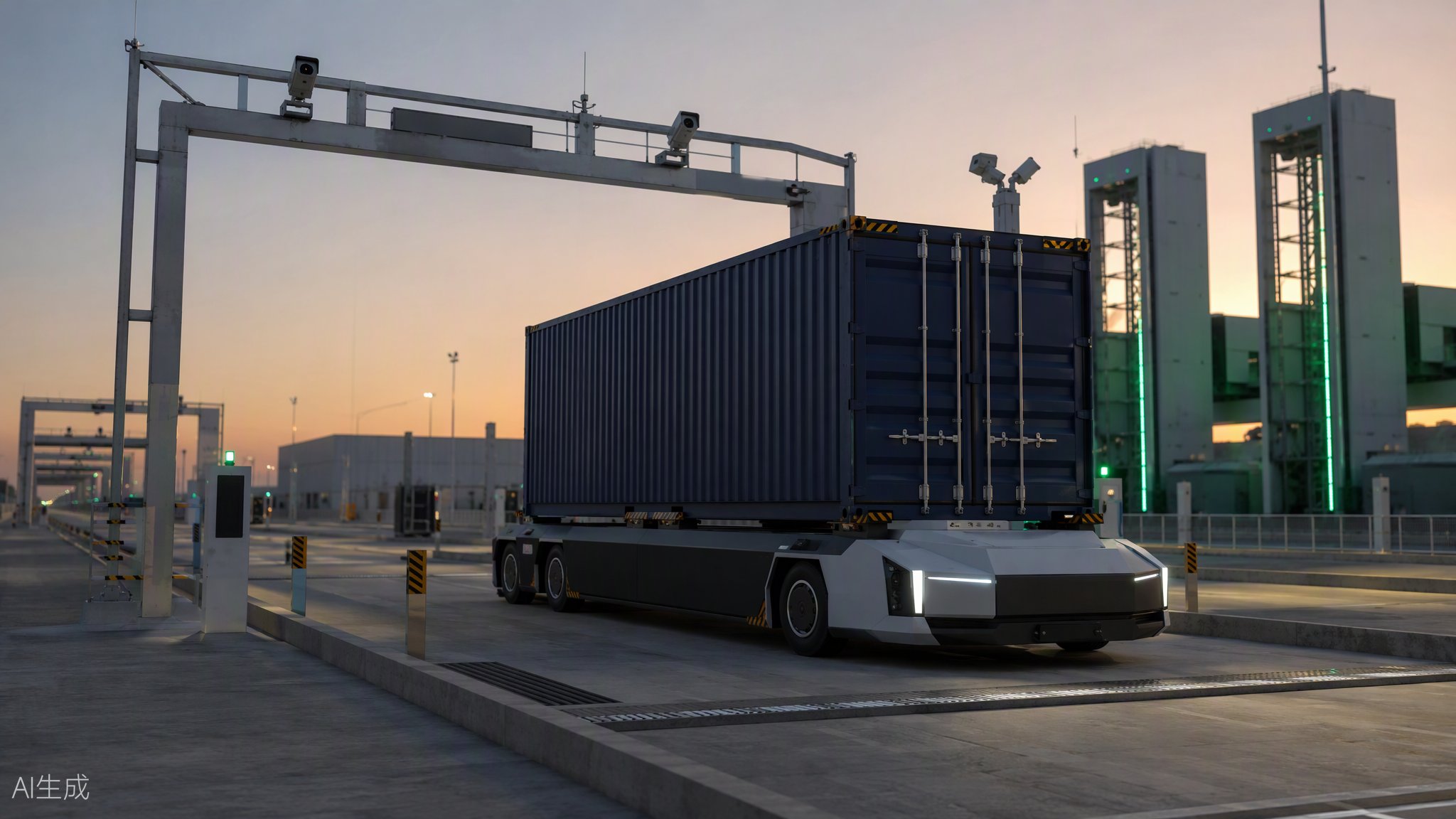
The new workhorse: an IGV unmanned truck clears the automated bay at Friendship Pass. Energy, handling and inspection were rebuilt as one system — that is why the gains compound rather than add up.
1. The Legacy Ledger: What the Old Gate Actually Cost#
Before the automation layer, Friendship Pass's bottleneck was arithmetic, not policy. Social trucks delivered containers to the gate and waited — for cranes, for connecting vehicles, for manual verification. Average single wait for connection was ~40 minutes; human drivers capped effective daily operation at 8–12 hours, and the gate went semi-dormant at night. In 2023 the average clearance time was 4.2 hours, with energy补给 and operational衔接 consuming over 20% of that.
The fuel ledger was just as concrete: diesel trucks averaged 82 litres/day, over ¥600/day in fuel alone, with ~8 maintenance visits, ~3 overhauls and ~15 engine failures per truck-year — each failure a cascade of delayed boxes.
For ordinary cargo that friction is a margin tax. For Friendship Pass it is existential, because the pass is one of China's largest land fruit gateways: fresh-cargo delay losses ran at about 5%, a number that lands directly on perishables margins. And on the export side, the cargo is disproportionately time-structural — roughly 70% of export value is electronic intermediates feeding the Bắc Ninh–Bắc Giang electronics cluster, where the Apple/Samsung-chain "N+1" model means a northern-Vietnam factory orders today and expects goods tomorrow. A border that sleeps 13 hours a day is a missing link in that timetable, which is precisely what the smart-port program was built to remove.
2. The Teardown: Three Segments Fixed at Once#
Most port upgrades fix one link. The Friendship Pass design is notable because energy, handling and inspection were rebuilt as a single system — and the gains compound across segments.
Energy — the 1.9-minute swap. The IGV fleet's battery-swap station has a 2,500-kVA supply; one station keeps 50 trucks charged around the clock. When charge drops below 30%, the vehicle requests a swap automatically, the system routes it, the station pre-stages a battery, and the exchange takes 1.9 minutes with no human in the loop. Against 2–3-hour conventional charging, the swap isn't an improvement but a category change: it is what stretches daily operation to 22 hours. The truck doesn't need a shift break; it needs ninety seconds.
Handling — turnover, not headcount. The automated container bay runs five fixed cranes at 24 TEU per hour — 2,880 TEU/day — with a 20-TEU temporary stacking buffer so exporters "drop and go" and importers "collect and leave". Unmanned trucks turn at 3–4× the human rate; with the same fleet size, rotation time fell from 9 hours to 3, which is where the capacity multiplication actually comes from: throughput is turned, not saved. Single customs declarations compressed from 10 minutes to under 3.
Inspection — seconds and hours. Since 1 Jan 2026, Vietnamese-driver trucks and unmanned vehicles joined the fast-clearance regime: document-plus-biometric checks dropped from 1 minute to 15 seconds (−75%), letting one officer cover three lanes. Vehicle dispatch and smart queueing lifted parking-bay turnover 35% and cut berth waiting 20%. In the lab, an RPA robot replaced the 4–5-person sampling shift around the clock, and quarantine identification fell from 3–5 days to 36 hours. Customs cites +40% overall clearance efficiency on the new equipment with AI image recognition.
Stacked together, the port's structural capacity doubled: traditional gate hours are 08:00–19:00, the smart port runs 24 hours — ~13 extra clearance hours every day — and the full ¥1.06 bn program targets over 4,000 crossings/day once the Vietnam-side segment completes in October 2027, with Nanning–Hanoi 24-hour direct freight on the roadmap. For corridor context, this is the land-side mirror of what the Pinglu Canal did on the water side: both replace a detour-limited, hours-bound route with a scheduled, near-continuous one (corridor explainer).
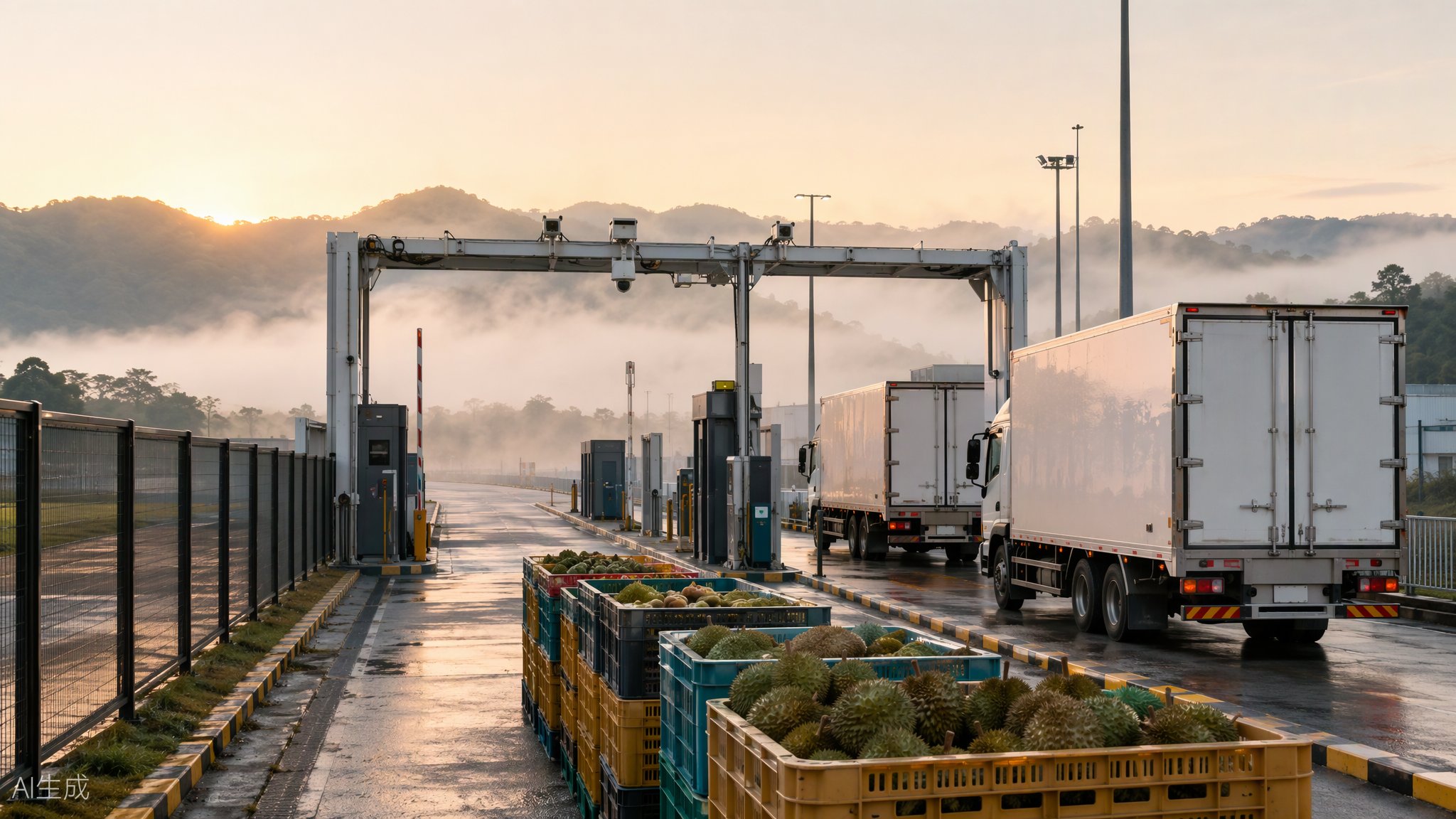
The fruit ledger funds the build: ~2 in 5 imported durians clear at Friendship Pass, and legacy fresh-cargo delay loss ran near 5%. Thirteen extra daily clearance hours are shelf-life hours.
3. Two Cargo Ledgers That Justify the Build#
Fruit, inbound. Jan–Aug 2026 brought ¥17.61 bn of durian (620,000 t) through the pass — roughly two of every five imported durians nationwide. Pre-automation, the 4.2-hour average clearance plus night dormancy translated directly into that ~5% fresh loss; every efficiency hour recovered is margin recovered. For seasonal planners this is the quantitative backing for the CNY fruit-lane timing work published earlier on this site (Thai fruit lane, CNY 2027 lane costs): the border is no longer the constraint it was two seasons ago, and booking windows should be re-based on the new cadence.
Electronics, outbound. Roughly 70% of export value is electronic intermediates: Yangtze/Pearl River Delta upstream components cross at Píngxiáng into Bắc Ninh–Bắc Giang for processing, then on to global assembly. Píngxiáng industrial-park firms run Apple/Samsung-chain配套 under "N+1" — order today, arrive tomorrow. That cadence only survives if border time is near-deterministic, which is exactly what 15-second checks and 36-hour quarantine buy. Electronics shippers should treat the smart port as scheduled infrastructure, the way the canal's lock timetable is treated on the water leg (route map).
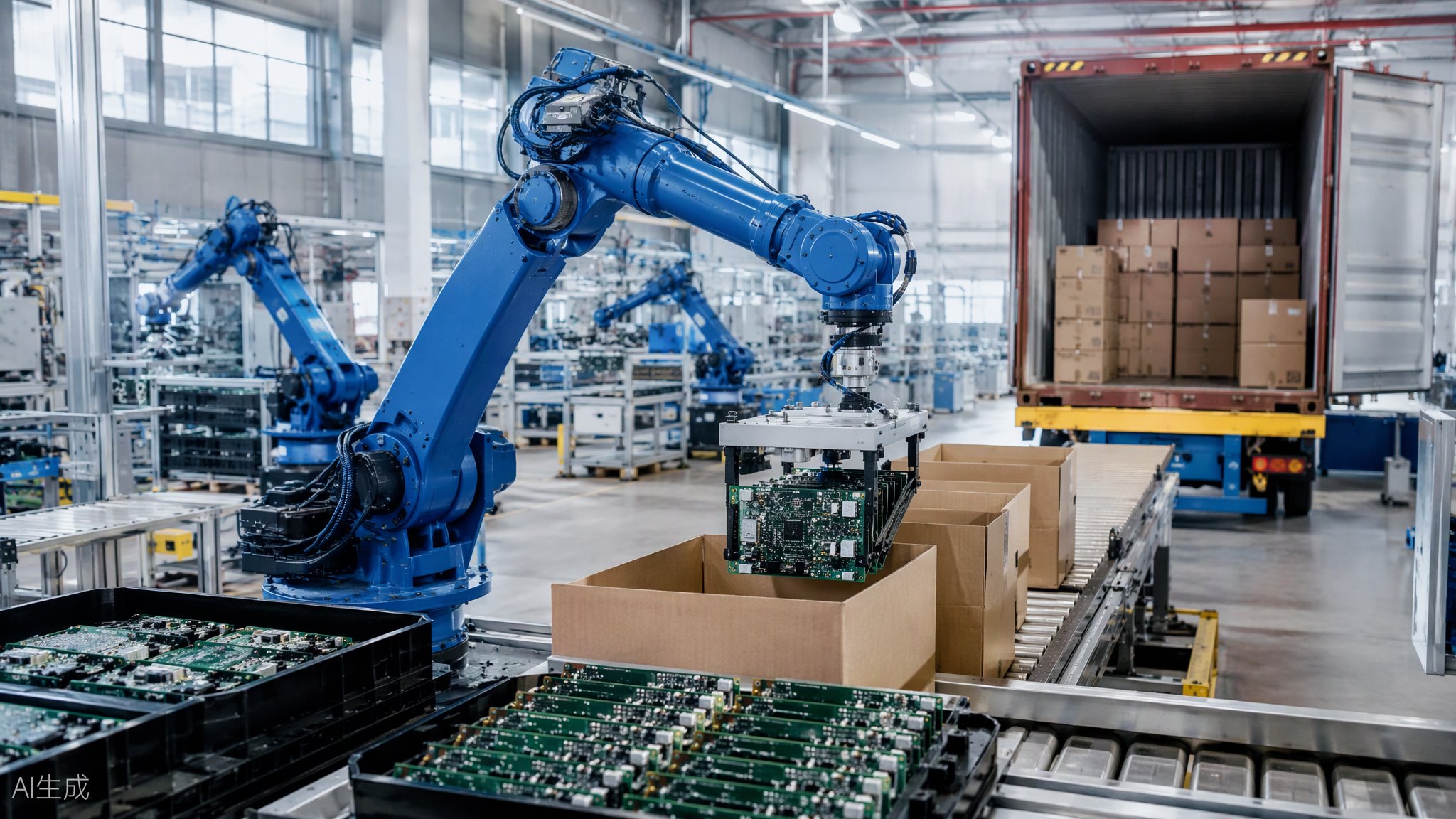
The export ledger: upstream electronic intermediates bound for Bắc Ninh–Bắc Giang under an "N+1" next-day cadence. Deterministic border time — 15-second checks, 36-hour quarantine — is what keeps that promise.
4. Compliance Alert: The "Relabel Route" to a Vietnam Certificate Is Closing#
One counterpoint belongs in every Vietnam-corridor plan right now. Vietnamese customs has escalated origin trace-back audits targeting goods that undergo only repackaging/relabelling before claiming Vietnam origin for EU/US-bound re-export. Auditors trace core materials and components backward; if the core inputs are confirmed Chinese-origin, the goods fail "made in Vietnam" scrutiny regardless of new packaging — certificates are revoked, cargo detained, fines applied, and downstream EU/US customs can escalate secondary inspections.
Hanoi's motivation is self-protection: being branded a transshipment loophole invites anti-dumping and penalty-tariff blowback on Vietnam's own exports. The only durable path to a Vietnam origin certificate is now substantial transformation — sufficient local processing and value-added to satisfy rules-of-origin tests.
Sourcing note: this item is an industry alert circulating via trade-promotion-council and customs-warning channels (Oct 2026); we have not located the governing official text, so treat specifics as directional and re-verify with your customs broker. The operational read is safe regardless: audit-proof your origin documentation before routing. For the checklist side, see the Form E / RCEP rules-of-origin guide.
5. The 13-Hour Window: A Shipper's Playbook#
- Re-base booking windows on the new cadence. With quarantine at 36 hours and 24-hour gate operation, the border no longer dictates multi-day buffers for fruit programs. Re-run seasonal timing models — especially pre-CNY.
- Split fragile/urgent cargo toward the smart gate. The traditional lane (08:00–19:00) still exists and queues; time-sensitive boxes belong on the automated lanes.
- Build the 2027 Vietnam-segment completion into contracts. Crossings >4,000/day and Nanning–Hanoi 24-h direct are scheduled for after the Vietnam side completes (Oct 2027). Quotes spanning that date should say so explicitly.
- Treat origin compliance as lane infrastructure. Post-audit, an unclean certificate is a stranded container. Substantial-transformation evidence now belongs in the same folder as the booking.
- Model the corridor end-to-end. Border minutes are only one leg — pair this teardown with the cost simulator for the canal and sea legs, and audit counterparties in the verified supplier directory.
FAQ#
Is Friendship Pass really running unmanned trucks at the border now?#
Yes — IGV unmanned trucks are in live container接驳 operation with a 1.9-minute battery swap and 22-hour daily utilization; Vietnamese-driver trucks and unmanned vehicles have been in the 15-second fast-clearance regime since 1 Jan 2026.
How much extra crossing capacity does the smart port add?#
Roughly 13 extra clearance hours per day (24-h operation vs 08:00–19:00), and design capacity rises to >4,000 vehicle crossings/day — more than double current throughput — once the Vietnam-side segment completes in Oct 2027.
What does this mean for fruit importers?#
Directly: less dwell, less loss. Legacy fresh-cargo delay loss was ~5%; clearance compression (15-sec checks, 36-h quarantine, 24-h gate) attacks exactly that number. Booking windows and cold-chain buffers built two seasons ago are now oversized.
What does it mean for electronics shippers?#
Determinism. The export book is ~70% electronic intermediates on a next-day "N+1" cadence into Bắc Ninh–Bắc Giang; that cadence survives only with predictable border time, which is the design goal of the automation stack.
Should we still route China-origin goods through Vietnam for EU/US export?#
Only with substantial local processing. The relabel-and-reexport path is under active trace-back audit; certificates are being revoked and downstream inspections triggered. Get a rules-of-origin opinion before routing (see §4 and the Form E checklist).
Methodology & Data Sources#
Operational figures are from published reporting on the Friendship Pass smart-port program (engineering parameters) and government trade disclosures (volumes and values); corridor context is cross-linked to prior site coverage. The compliance item in §4 is an industry alert and is labeled as such. No unsourced freight rates are published per this site's sourcing rules; labeled planning arithmetic is used only where noted.
- IGV battery-swap parameters (1.9 min; 2,500 kVA; 50-vehicle coverage; <30% auto-request); 22-h daily operation — Science and Technology DailyA, Oct 2026 (via OFweek aggregation, 31 Oct 2026)
- Automated bay throughput (5 cranes × 24 TEU/h = 2,880 TEU/day; 20-TEU buffer); unmanned turnover 3–4×; declaration 10 min → <3 min — Science and Technology Daily, Oct 2026 (via OFweek aggregation, 31 Oct 2026)
- Fast-clearance regime (1 min → 15 sec, −75%, one officer three lanes; parking +35%; berth −20%; lab 3–5 days → 36 h; RPA replacing 4–5 staff; overall +40%) — 21st Century Business HeraldA, Oct 2026
- Legacy ledger (40-min connection wait; 4.2-h average clearance 2023; energy/衔接 >20%; 82 L/day; >¥600/day; 8 maintenance / 3 overhauls / 15 failures per year) — media reporting on legacy operations, Oct 2026 (via OFweek aggregation)
- Fresh-cargo delay loss ~5%; durian Jan–Aug 2026 ¥17.61 bn / 620,000 t; ~2 in 5 imported durians — Pingxiang Municipal GovernmentS disclosures, 2026; see also H1 2026 fruit figures
- Smart-port investment ¥1.06 bn; China segment tested end-to-end; Vietnam segment Oct 2027; >4,000 crossings/day; >2× capacity; Nanning–Hanoi 24-h direct — regional press reporting, Oct 2026; 2025 crossings >1 million vehicles (first); Jan–Aug 2026 ¥513.6 bn, +31.2% — Guangxi Department of CommerceS / Guangxi government press conferenceS, 2026
- Export mix ~70% electronic intermediates; Bắc Ninh–Bắc Giang cluster; "N+1" next-day cadence; Apple/Samsung-chain配套 in Píngxiáng park — corridor reporting, Oct 2026 (via OFweek aggregation)
- Vietnam origin trace-back audit escalation (relabel route; certificate revocation, detention, fines; EU/US secondary inspection; substantial-transformation requirement) — industry alert via trade-promotion-council and customs-warning channels, Oct 2026 (industry alert; official text not yet located)
Get a Tailored Logistics Assessment#
Run the full corridor in the cost simulator — border, canal and sea legs together — or apply to be listed in the verified supplier directory. Reference values only; not a formal quote.