Public Beta · Operational data as of 15–17 Oct 2026. We cite operators and state media, and we flag what remains unproven. This page exists to be challenged.
The Month in Numbers#
| Metric | First-month value | Source tier |
|---|---|---|
| Canal total transit volume | 950,000+ t (16 Sep–15 Oct) | CLS.cn field report |
| Liujing terminal throughput | 266,600 t (to 11 Oct); pre/post-opening week: <34,000 t → >90,000 t | People's Daily Guangxi / port operator |
| Nanning Port September | 668,400 t, +145% y/y; National Day week +21× y/y | CCTV-sourced / operator |
| Lock cycles | 3–4/day at opening → 7–8/day by mid-Oct | Canal construction co. (CLS.cn) |
| Lock chamber capacity | Up to 6 × 5,000-t vessels per cycle; ~20 cycles/day per lock designed | Canal construction co. |
| Lock transit time | Qingnian 7–8 min fill/drain; Madadao & Qishi ~15 min; 70–80 min end-to-end | Canal construction co. |
| Wait-time target | ≤3 h per lock, same-schedule batching for arrivals within a window | Canal construction co. |
| Directional balance | Upstream (inland-bound) freight slightly exceeds downstream | Canal construction co. |
| Digital layer | 20,000+ sensors, BeiDou + AI dispatch, one-file-per-ship, single declaration for the whole line | China News Service |
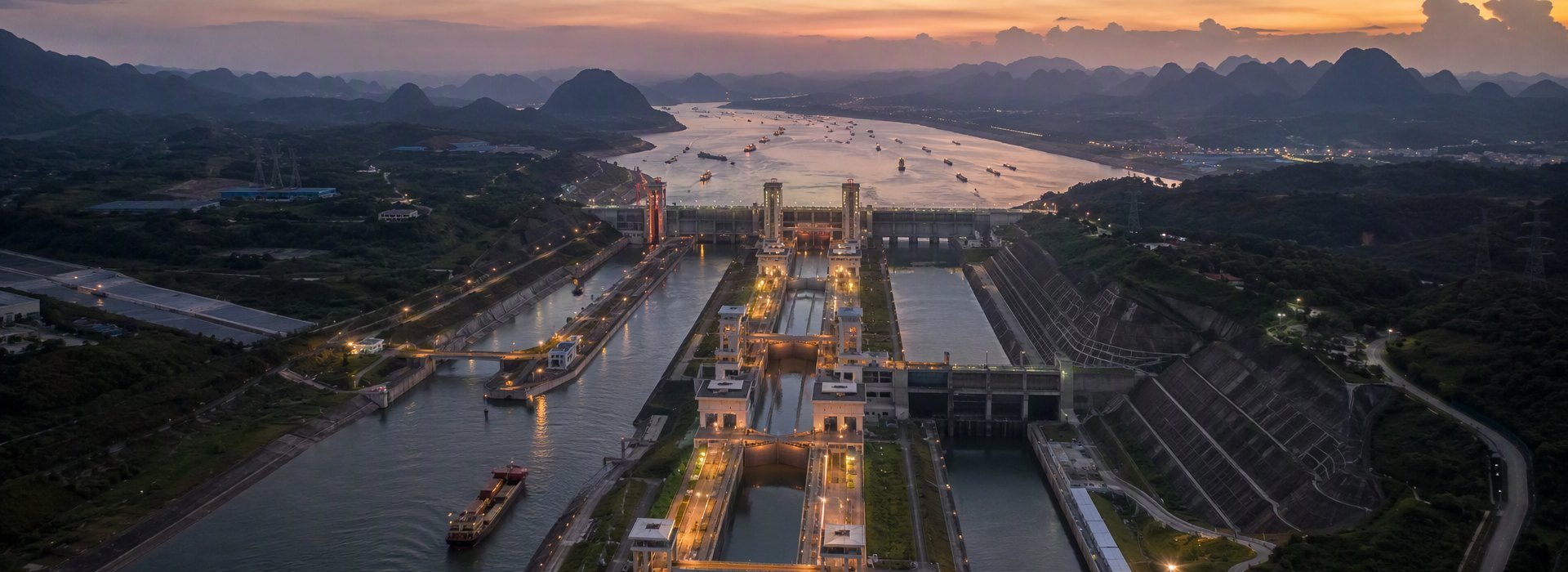
Three lock flights drop vessels 65 m from the Nanning basin to sea level. First-month data says the system is scaling — with caveats.
What Actually Worked#
The dispatch layer is the quiet success. The integrated river-canal-sea platform assigns lock chambers and water levels algorithmically before ships arrive; one declaration covers the full through-movement. A ship's entire file — position, schedule, cargo — is generated automatically ("one ship, one file"). For planners, this means transit is becoming appointment-based rather than queue-based, the single biggest difference from legacy inland-waterway practice in China.
Lock throughput doubled in four weeks. From 3–4 cycles a day at opening to 7–8 by mid-October, against a design headroom of ~20 per lock per day. Fill/drain cycles of 7–15 minutes are genuinely fast for this lock class. The system is running at roughly a third of designed capacity — headroom exists, but only if arrivals can be batched.
Two-way cargo appeared immediately. The headline maiden voyages were exports (chemicals, board products, KD auto parts to Cần Thơ), yet by mid-October upstream tonnage slightly exceeded downstream. The clearest example: Guinean bauxite unloaded at Qinzhou, barged up the canal to Nanning, then over-transhipped to 1,000-t river craft for Baise's aluminum industry. The canal is already an inbound raw-material artery, not just an export lane.
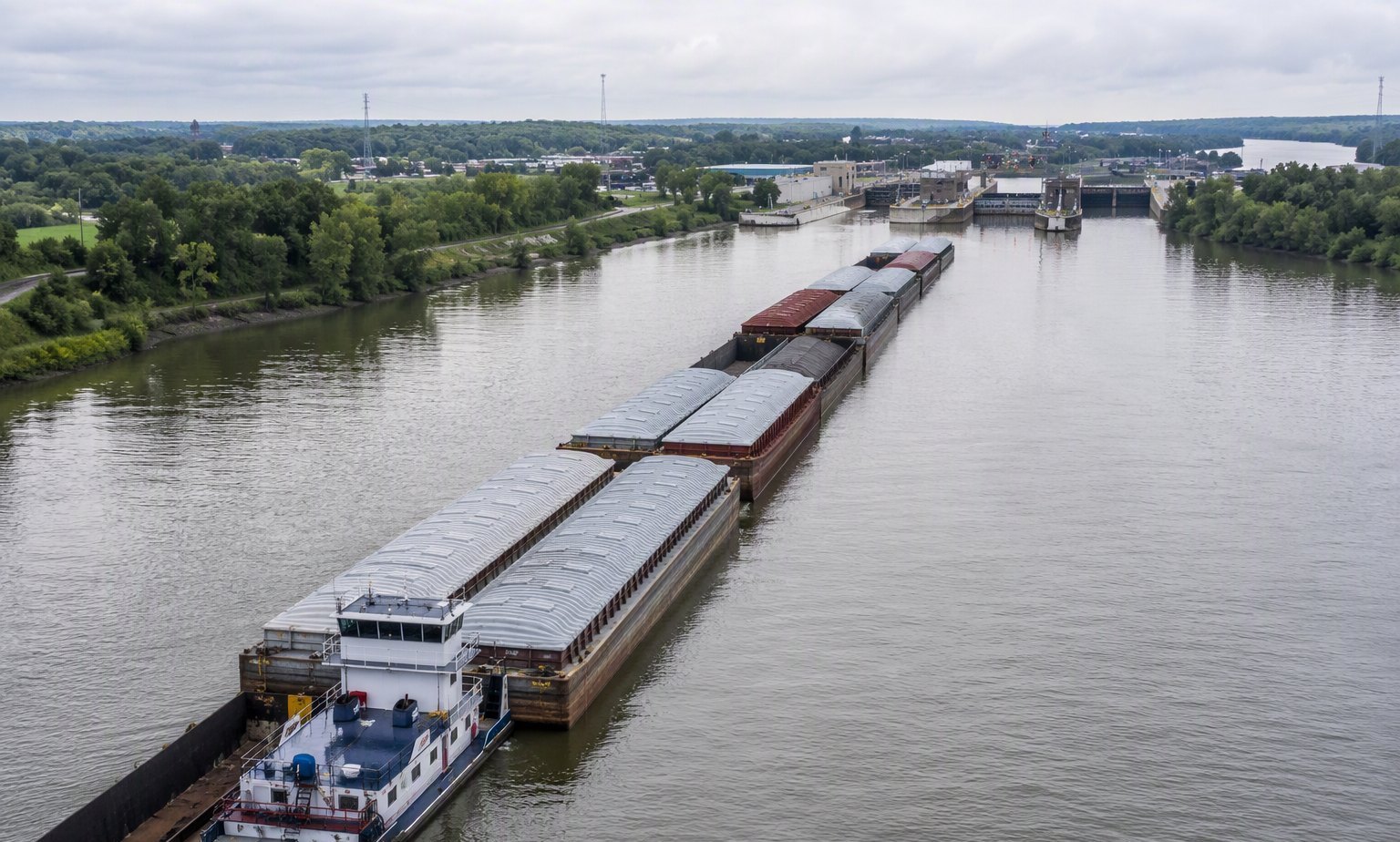
Batched lock scheduling: vessels arriving within the same window are grouped into one cycle — the mechanism behind the ≤3-hour wait target.
What Is Still Rough#
Wait times are managed, not solved. The operator's own framing — "we work to keep waits within 3 hours" — is a target statement. During the National Day surge (throughput +21× y/y), queues were the port's own admitted pressure point. Shippers should still pad schedules during Chinese holiday windows.
Customs and documentation are weeks old. Nanning Port's inland supervision site went live with the canal. Inland clearance is a genuine advantage (no coastal detour for paperwork), but expect edge cases — new commodity codes, dangerous-goods certificates (the terminal received Guangxi's first inland dangerous-goods handling licence only in June 2026) — to resolve slowly.
Backhaul and empty-container repositioning remain the economics test. A feeder survives on round-trip utilization. The Cần Thơ backhaul maiden voyage carried produce, which is promising; but sustained frequency of balanced loads is unproven beyond the first month. This is the metric to watch through Q1 2027.
The last-mile rail link is not finished. Liujing's dedicated railway spur is due by year-end; until then, rail-to-ship transfers run through the existing yard. "Arrive-at-station, enter-port" seamless transfer is still a construction promise.
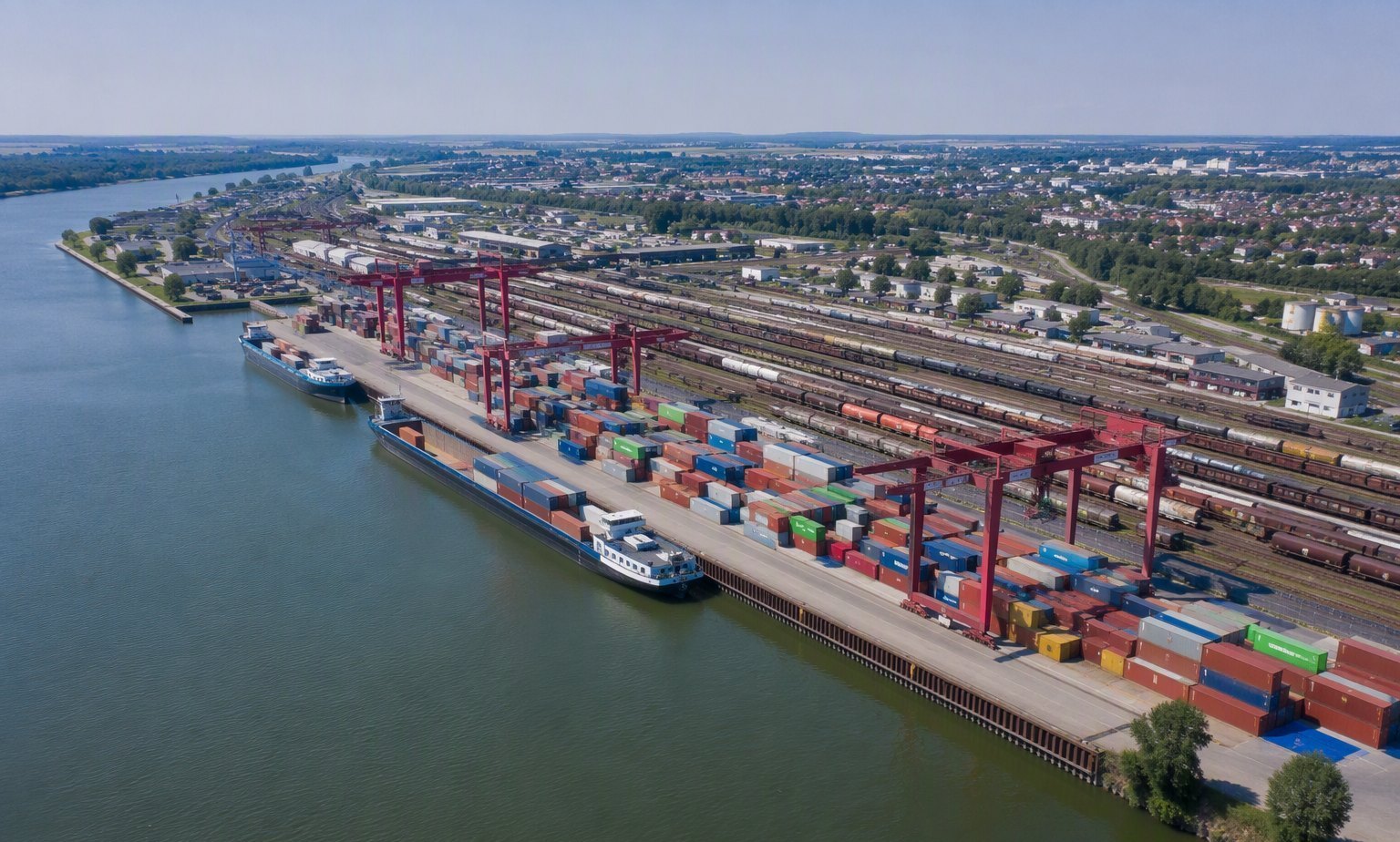
Liujing terminal, 50 km from the canal head: the rail spur due by end-2026 will close the last gap in the rail-river-sea chain.
How Buyers Should Plan (Next 90 Days)#
- Pad, then compress: for shipments before year-end, add 1–2 days of schedule buffer; tighten only after your second or third uneventful transit.
- Batch your arrivals: lock scheduling rewards ships arriving in groups within the same window — ask carriers about convoy scheduling instead of chasing single-slot departures.
- Use inland clearance where possible: export declaration at Nanning saves the coastal detour, but double-check commodity codes with the terminal before the cargo moves.
- Book backhaul early: Vietnamese agricultural produce, aquaculture and Delta light goods are the natural return loads — if you import from the Delta, the cheapest northbound capacity this quarter is on these new barges.
- Re-check the toll calendar: lockage is free through 31 Dec 2026; the trial tariff (RMB 1.0/GT/lockage) starts 1 Jan 2027 — negligible per container, but confirm your forwarder's billing assumption.
Methodology & Data Sources#
First-month figures are drawn from field reporting and operator statements gathered during the "Vibrant China" press tour (11–16 Oct 2026), cross-checked across at least two outlets where possible. Projections (18–30% cost reduction, >¥5 bn/yr societal saving) are official estimates, not measured results — we label them as such.
- Canal transit >950,000 t (to 15 Oct); lock cycles 3–4 → 7–8/day; chamber capacity ≤6×5,000 t; 70–80 min end-to-end transit; ≤3 h wait target; upstream freight slightly ahead — CLS.cnA (财联社) field report, 16 Oct 2026
- Liujing 266,600 t (to 11 Oct); pre/post week <34,000 → >90,000 t; single-day >10,000 t on 17 Sep — People's Daily Guangxi / Guangxi News, 12–16 Oct 2026
- Nanning Port Sep throughput 668,400 t (+145% y/y); National Day +21×; new 40 t/40 m crane 300→800 t/h, ¥15–20/t saving — CCTVA-sourced reports / Economic ObserverA, 13–15 Oct 2026
- 20,000+ sensors, BeiDou+AI, one-file-per-ship, single-declaration through transit; "equivalent-A waters" direct berthing at seaport — China News ServiceA, 16 Oct 2026
- Chongqing–Nanning first export rail feeder (7 Sep); Nanning–Yangpu & Nanning–Cần Thơ maiden voyages (16 Sep); Cần Thơ backhaul with produce (24 Sep) — Eastmoney / Dahecaifu / CCTV, 13–14 Oct 2026
- Guinean bauxite Qinzhou → canal → Nanning → Baise over-transhipment — CCTV report via SohuB, 13 Oct 2026
- Official projection: logistics cost −18–30%, >¥5 bn/yr societal saving; 560+ km shorter — China News Service / United Front Work Dept site, 14 Oct 2026
- Lockage free through 31 Dec 2026; trial rate RMB 1.0/GT/lockage from 1 Jan 2027 — 桂发改价费规S〔2026〕533号; Guangxi press conference, 7 Sep 2026
Get a Tailored Logistics Assessment#
Run your own numbers in the cost simulator — or apply to be listed in the verified supplier directory. Reference values only; not a formal quote.